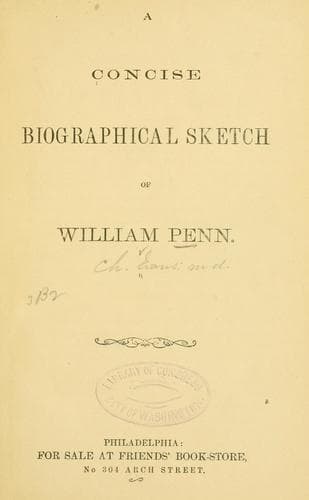
A Concise Biographical Sketch of William PennEvans, Charles
History
A Concise Biographical Sketch of William Penn
Evans, Charles
Penn, William, 1644-1718
Those who came first, as was to be expected, had to encounter the
difficulties and privations usually attending pioneers in an
uncultivated forest. Some, who brought the frames of small houses with
them, were not long in obtaining a comfortable shelter; but very many
were obliged to content themselves with hastily constructed shanties,
under the overarching branches of trees; while some dug caves in the
bank of the river, and made out to obtain in them some of the comforts
of a home. This was before William Penn came out; but Richard Townsend,
who came in the same ship with him, thus speaks of his experience: "At
our arrival we found it a wilderness; the chief inhabitants were
Indians; there were some Swedes, who received us in a friendly manner;
and although there was a great number of us, the good hand of Providence
was seen in a particular manner, in that provisions were found for us by
the Swedes and Indians, at very reasonable rates; as well as brought
from divers other parts, that were inhabited before. Our first concern
was to keep up and maintain our religious worship, and in order thereto,
we had several meetings in the houses of the inhabitants; and one
boarded meeting-house was set up, where the city was to be (near the
Delaware); and as we had nothing but love and good-will in our hearts
one to another, we had very comfortable meetings from time to time, and,
after our meeting was over, we assisted each other in building little
houses for our shelter."
The high motives that prompted them to exile themselves from their
native land, and the fervent religious concern to be engaged in
promoting the spread of the Redeemer's kingdom, which warmed their
hearts, enabled them to bear all they had to endure with cheerfulness.
One of them thus expresses himself: "Our business in this new land is
not so much to build houses, and establish factories, and promote trade
and manufactures, that may enrich ourselves (though all these things,
in their due place, are not to be neglected), as to erect temples of
holiness and righteousness, which God may delight in; to lay such
lasting frames and foundations of temperance and virtue as may support
the future superstructures of our happiness, both in this and the other
world."
Public-domain text, read in full here on John Shaqi.
Reviews
Reviews
No reviews yet
Be the first to share your thoughts on this work.
Join the Discussion
Join the discussion
Sign in to leave a comment or review.
Sign InorCreate an account