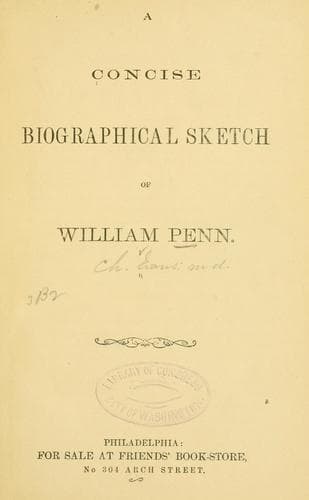
A Concise Biographical Sketch of William Penn — John Shaqi
A Concise Biographical Sketch of William PennEvans, Charles
History
A Concise Biographical Sketch of William Penn
Evans, Charles
Penn, William, 1644-1718
He had been commended by his father, on his death-bed, to the good
offices of the then Duke of York. The respect and kind feeling of the
Duke for William Penn appeared to have continued after he became King;
and a sense of gratitude and Christian interest, in measure, bound the
man he had befriended to his royal benefactor. He was almost daily at
Court, and as often his interest there was employed on behalf of those
with whom he was united in religious fellowship, or of others who
solicited his aid; which his kindness of heart prompted him not to
refuse. His house in Kensington was daily thronged with persons who
sought his mediation to promote their interests, or desired to engage
him to present their petitions or addresses to the King. He received all
with courtesy, and aided those he could with cheerfulness; and no one
ever charged him with making gain of his position or influence.
Nevertheless, in this way, it is probable he appeared in cases where
greater prudence would have restrained him from interfering. Certainly
he made many bitter enemies, who hesitated not to proclaim him to be a
Jesuit, a hypocrite, and an enemy to the Protestant interest. Accustomed
to calumny as a Friend, and conscious of his innocence, William Penn
allowed these slanders to possess the public ear, until they came to be
credited by many, who, without any particular prejudice against him,
supposed that, like other emissaries of Rome, he was in league with the
King in trying to subvert the religion and constitutional liberties of
the nation. At length the Secretary for the Plantations, who knew Penn
well, and was greatly grieved with the manner in which he was traduced,
and fearful of the ultimate result of his persistently declining
publicly to defend himself, addressed him by letter; reciting the
charges industriously circulated against him, and earnestly requesting
he would notice and refute them. To this letter William Penn replied,
taking up each accusation separately, and showing their untruth and
their absurdity. He did not hesitate to acknowledge the gratitude and
kind feeling he entertained toward King James, and that on some
occasions, when his opinion had been sought on matters affecting the
nation, he had given it; but he declared that, on all such occasions, he
had advocated liberty of conscience, and the best interest of Protestant
England; and he challenged any one to come forward and show to the
contrary. Notwithstanding this explanation of his intimacy at Court, and
his positive denial and refutation of the many false stories raised
about him, the feeling produced by them was not entirely removed; and in
the last month of 1688, as he was walking in Whitehall, he was suddenly
summoned to appear before the Lords of the Council. Some of the Council,
who were inimical to him, required him to give sureties for his
appearance on the first day of the next term of Court. On his appearance
there, his case was postponed until the next session; when there
Public-domain text, read in full here on John Shaqi.
Reviews
Reviews
No reviews yet
Be the first to share your thoughts on this work.
Join the Discussion
Join the discussion
Sign in to leave a comment or review.
Sign InorCreate an account