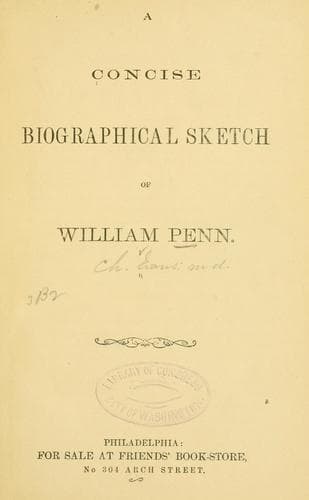
A Concise Biographical Sketch of William Penn — John Shaqi
A Concise Biographical Sketch of William PennEvans, Charles
History
A Concise Biographical Sketch of William Penn
Evans, Charles
Penn, William, 1644-1718
arrangements, he was again brought into difficulty, more serious than at
any time before, on account of his connection with the Court of King
James. King William had crossed over to Holland, to be present at a
Congress held at the Hague, and his absence emboldened the disaffected
to enter into another plot for restoring James, who was then at the
Court of Louis XIV. Two of their number started to cross the Channel,
and have an interview with their absent sovereign; but the plot was
discovered, and these emissaries, with their papers, seized. One of
them was hung; the other, in order to save his life, gave testimony
against several of the nobility, and implicated William Penn in the
conspiracy. A warrant for his arrest was issued, and, on his return from
the funeral of George Fox, he narrowly escaped once more being made a
prisoner.
In what manner he was said to be connected with the conspiracy, or what
was the specific charge brought against him, is nowhere clearly stated;
but as Lord Preston--one of the captured messengers--declared he was one
of the plotters, and a man of the name of William Fuller swore to the
correctness of Preston's statement, the matter assumed a serious aspect.
As the origin of the plot was believed to have been among the Catholics,
the same misrepresentations of Penn being a Jesuit in disguise were
again brought forward, and the passions of the people being much
inflamed against the intriguing papists, it was thought a fair trial
could not be obtained for him. Under these circumstances, some accounts
represent that William Penn voluntarily secluded himself where he could
not be easily seen; waiting until a time should arrive when he might
have a fair opportunity to clear himself; while others state that,
having been examined before the Privy Council, he was ordered to remain
a prisoner in his own house, under surveillance. The latter is the more
probable, as he could hardly have supposed he could escape the search
the government would make for him; especially as he kept up intercourse
with his friends. Thus, in the Third month of 1691, he addressed an
epistle to the Yearly Meeting in London, in order to remove any
unfavorable impression that might have been made in the minds of his
brethren by his forced seclusion. In this he says: "My privacy is not
because men have sworn truly, but falsely, against me; for wicked men
have laid in wait for me, and false witnesses have laid to my charge
things that I knew not; who have never sought myself, but the good of
all, through great exercises; and have done some good, and would have
done more, and hurt to no man; but always desired that truth and
righteousness, mercy and peace, might take place among us."
Public-domain text, read in full here on John Shaqi.
Reviews
Reviews
No reviews yet
Be the first to share your thoughts on this work.
Join the Discussion
Join the discussion
Sign in to leave a comment or review.
Sign InorCreate an account