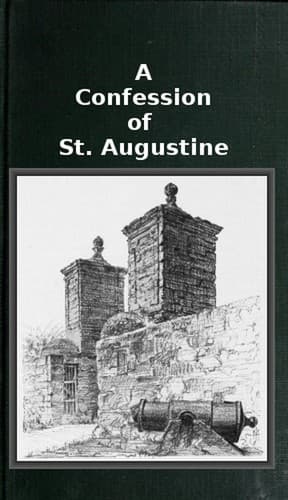
A Confession of St. AugustineHowells, William Dean
History
A Confession of St. Augustine
Howells, William Dean
Saint Augustine (Fla.) -- Guidebooks
If the reader is still, as I hope, in the Plaza with me, I would have
him leave our places on the Mid-Western benching, and come and lean over
the rail which keeps the dogs and boys from throwing themselves to the
alligator in his pool there, where he lies stiller than the stone of
his bath. In some moment when the water is coldest he rises to the sun
and basks motionless and soundless on the stone curbing, but no one ever
saw him unlid those loathly eyes of his, or stir those antediluvian
limbs. Ever, do I say? This is wrong. I myself have seen the monster
raise himself on his hideous arms and legs and, “being wrought upon in
the extreme” by his intolerable prescience of a change in the weather,
lift his head and roar--roar as the jungled lion roars, or as the bull
that sees his rival cross the meadow where he ranges in challenge to
mortal combat. Nothing in nature has more surprised me, and the effect
with my fellow home-towners was the same; they came running from, the
benches--men, women, and children--and hung upon the alligator’s fence
and wondered and worshiped like so many idolaters of some serpent of Old
Nile, till his bellow subsided into a hoarse bleat, and then a long sigh
that shook the disgusting folds of his throat into silence.
Several times already in this study of the Plaza I have tried to mention
the ivied Gothic of the Episcopal church which faces the southwestern
corner, and then the galleried upper stories of the line of shops
stretching eastward forming a picturesque recall of the St. Augustine
which was once so much more all galleries than the ancient city now is.
But I could not somehow leave the intersecting paths and the flower-beds
beside them, or that gentle little Canovan figure with ankles crossed
and wrists on hips which discreetly invites from its pedestal the
home-towner unfolding his paper as he advances to place himself with his
back to the sun on a favorite bench. Still less could I leave the
somewhat plain, not to say severe, obelisk near the fountain which
celebrates in stately inscriprional Spanish the promulgation of the
constitution of 1812. Which king of the several constitution-giving
sovereigns of Spain it was who gave that charter of the national
liberties I do not know or much care to know. The charm, the
provincial-patriotic charm of the obelisk remains, as it remains with
every crumbling ruin of the city which the Spanish colonists builded and
as you feel it at many points on the swerving, rather than curving,
narrow ways between St. George Street and the bay-front. I here the
wooden balconies droop from the drooping wall of time-stained coquina;
the doors and windows open flush upon the sidewalks; the little gardens
cherish a few onions and heads of lettuce; the dooryard trees support
themselves in the friendly angles and ripen, slowly ripen their plums,
their peaches, their guavas, their figs, and such other fruits as love a
sunny exposure in literature.
[Illustration: THE SPANISH FORT]
Public-domain text, read in full here on John Shaqi.
Reviews
Reviews
No reviews yet
Be the first to share your thoughts on this work.
Join the Discussion
Join the discussion
Sign in to leave a comment or review.
Sign InorCreate an account