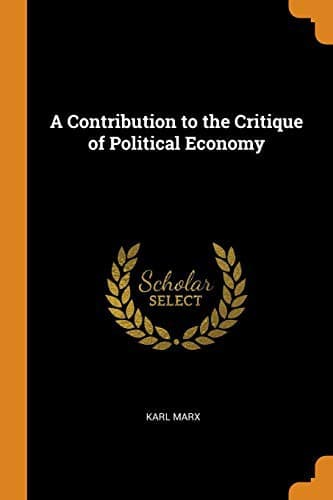
A Contribution to the Critique of Political EconomyMarx, Karl
Philosophy
A Contribution to the Critique of Political Economy
Marx, Karl
Economics; Marxian economics
because there is an antagonism between different members of society.
One has to occupy himself with price and value only where there is
sale and purchase, that is to say, where every individual is obliged
to struggle to procure for himself the objects necessary for the
maintenance of his existence.”)
[69] “L’argent n’est que le moyen et l’acheminement, au lieu que les
denrées utiles à la vie sont la fin et le but.” (“Money is but the ways
and means, while the things useful in life are the end and object.”)
Boisguillebert: “Le Détail de la France,” 1697, in Eugene Daires’
“Economistes financiers du XVIIIieme siècle, vol. I., Paris, 1843, p.
210.
[70] In November, 1807, William Spence published a pamphlet in England
under the title: “Britain Independent of Commerce.” The principle set
forth in this pamphlet was further elaborated by William Cobbet in
his “Political Register” under the virulent title, “Perish Commerce.”
To this James Mill replied in 1808 in his “Defence of Commerce” which
contains the passage quoted above from his “Elements of Political
Economy” (p. 190-193, Transl.). In his controversy with Sismondi and
Malthus on commercial crises, J. B. Say appropriated this clever
device, and as it would be difficult to point out with what new idea
this comical “prince de la science” had enriched political economy, his
continental admirers have trumpeted him as the man who had unearthed
the treasure of the metaphysical balance of purchases and sales; as a
matter of fact, his merits consisted rather of the impartiality with
which he equally misunderstood his contemporaries, Malthus, Sismondi
and Ricardo.
[71] The manner in which economists explain the different aspects of
the commodity may be seen from the following examples:
“With money in possession, we have but one exchange to make in order
to secure the object of desire, while with other surplus products
we have two, the first of which (procuring the money) is infinitely
more difficult than the second.” (G. Opdyke, “A Treatise on Political
Economy,” New York, 1851, p. 277-278.)
“The superior saleableness of money is the exact effect or natural
consequence of the less saleableness of commodities.” (Th. Corbet, “An
Inquiry into the Causes and Modes of the Wealth of Individuals.” etc.,
London, 1841, p. 117.)
“Money has the quality of being always exchangeable for what it
measures.” (Bosanquet, “Metallic, Paper and Credit Currency,” etc.,
London, 1842, p. 100.)
“Money can always buy other commodities, whereas other commodities
can not always buy money.” (Th. Tooke, “An Inquiry into the Currency
Principle,” 2d ed., London, 1844, p. 10.)
[72] The same commodity can be bought and resold many times. It
circulates, then, not merely as a commodity, but in a capacity which
does not exist from the point of view of simple circulation, of the
simple contrast of commodity and money.
Public-domain text, read in full here on John Shaqi.
Reviews
Reviews
No reviews yet
Be the first to share your thoughts on this work.
Elsewhere in the archive
Join the Discussion
Join the discussion
Sign in to leave a comment or review.
Sign InorCreate an account