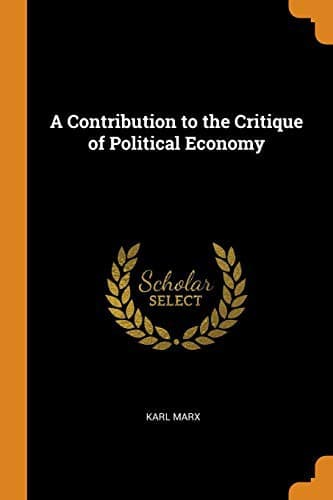
A Contribution to the Critique of Political EconomyMarx, Karl
Philosophy
A Contribution to the Critique of Political Economy
Marx, Karl
Economics; Marxian economics
[73] The quantity of money is immaterial “pourvu qu’il y en ait
assez pour maintenir les prix contractés par les denrées” (as long
as it is sufficient to maintain the existing prices of commodities).
Boisguillebert, l. c. p. 210.
“If the circulation of commodities of four hundred millions required a
currency of forty millions, and ... this proportion of one-tenth was
the due level, estimating both currency and commodities in gold; then,
if the value of commodities to be circulated increased to four hundred
and fifty millions, from natural causes ... I should say the currency,
in order to continue at its level, must be increased to forty-five
millions.” (William Blake, “Observations on the Effects Produced by the
Expenditure of Government, etc.,” London, 1823, p. 80.)
[74] “E la velocità del giro del danaro, non la quantità dei metalli
che fa apparir molto a poco il danaro.” (Galiani, l. c. p. 99.) (“It is
the rapidity of the circulation of money and not the quantity of metals
that causes a greater or smaller amount of money to appear.”)
[75] An example of an extraordinary decline of metallic circulation
from its average level was furnished by England in 1858, as may be
seen from the following extract from the London Economist: “From the
nature of the case (namely, the isolated nature of simple circulation)
very exact data cannot be procured as to the amount of cash that is
fluctuating in the market, and in the hands of the not banking classes.
But, perhaps, the activity or the inactivity of the mints of the
great commercial nations is one of the most likely indications in the
variations of that amount. Much will be manufactured when it is wanted;
and little when little is wanted.... At the English mint the coinage
was in 1855 £9,245,000; 1856, £6,476,000; 1857, £5,293,855. During 1858
the mint had scarcely anything to do.” (Economist, July 10, 1858.) But
at the same time about eighteen million pounds sterling were lying in
the bank vaults.
[76] Dodd, “Curiosities of Industry,” etc., London, 1854.
[77] “The Currency Question Reviewed, etc., by a Banker.” (Edinburgh,
1845, p. 69.)
“Si un écu un peu usé était reputé valoir quelque chose de moins qu’un
écu tout neuf, la circulation se trouverait continuellement arrêtée, et
il n’y aurait pas un seul payement qui ne fut matière à contestation.”
(G. Garnier, l. c. t. I., p. 24.) (“If an ecu slightly used would
pass for a little less than an entirely new ecu, circulation would be
continually interfered with, and not a payment would take place that
would not give rise to controversy.”)
[78] W. Jacob, “An Inquiry Into the Production and Consumption of the
Precious Metals.” (London, 1831, vol. II., ch. XXVI.)
[79] David Buchanan, “Observations on the Subjects Treated of in Dr.
Smith’s Inquiry on the Wealth of Nations,” etc. (Edinburgh, 1841, p. 3.)
Public-domain text, read in full here on John Shaqi.
Reviews
Reviews
No reviews yet
Be the first to share your thoughts on this work.
Elsewhere in the archive
Join the Discussion
Join the discussion
Sign in to leave a comment or review.
Sign InorCreate an account