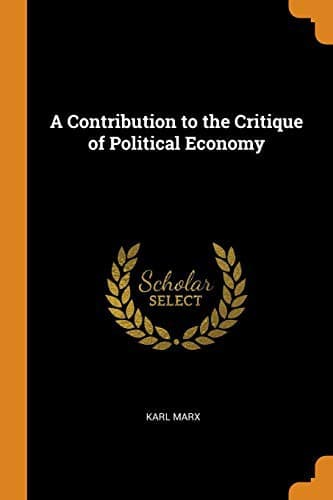
A Contribution to the Critique of Political EconomyMarx, Karl
Philosophy
A Contribution to the Critique of Political Economy
Marx, Karl
Economics; Marxian economics
He defines exchange value, however, just as it _appears_ in the process
of exchange of commodities, viz. as money; and money he defines as
an existing commodity, gold and silver. Laboring under the ideas of
the monetary system, he declares the special branch of labor which
is devoted to the production of gold and silver as the labor which
determines exchange value. What he really means is that the labor of
members of society must produce not direct use-values, but commodities
or use-values which by means of exchange are capable of assuming the
form of gold and silver, i. e. of money, i. e. of exchange value, i.
e. of embodiments of universal labor. His example, however, shows
strikingly that the recognition of labor as the source of material
wealth by no means excludes the misconception of the particular social
form in which labor constitutes the source of exchange value.
In his turn, Boisguillebert, if not consciously, at any rate actually
reduces the exchange value of a commodity to labor-time, since he
determines “true value” (la juste valeur) by the right proportion in
which the labor-time of individuals is distributed among the several
branches of industry, and defines free competition as the social
process which determines these correct proportions. At the same time,
however, and in contrast with Petty he wages a fanatical war against
money which, by its interference, disturbs the natural equilibrium or
harmony of exchange of commodities and, like a wanton Moloch, demands
all natural wealth as sacrifice. It is true that this assault on money
was called forth by certain historic conditions. Since Boisguillebert
attacked[18] the blind destructive lust after gold which possessed
the court of Louis XIV, his tax collectors, and his nobility; on the
other hand, Petty extolled in the greed of gold the mighty impulse
which spurred on the nation in her industrial development and in her
conquest of the world-market; still, there asserts itself here a
deeper antagonism of principles which constantly recurs between true
English and true French[19] Political Economy. Boisguillebert sees,
in fact, only the material substance of wealth, its use-value, the
enjoyment[20] of it, and considers the capitalistic form of labor, i.
e. the production of use-values as commodities and the exchange of
those commodities, as the natural social form in which individual labor
attains its end. When he is, therefore, confronted with the specific
character of capitalistic wealth as in the case of money, he sees in it
the usurping interference of extraneous elements and gets into a rage
about the capitalist system of labor in one form while utopian-like
he praises it in another.[21] Boisguillebert furnishes us with proof
that one may treat labor-time as the measure of value of commodities,
and at the same time confound labor embodied in the exchange value of
commodities and measured by time, with the direct natural activity of
individuals.
Public-domain text, read in full here on John Shaqi.
Reviews
Reviews
No reviews yet
Be the first to share your thoughts on this work.
Join the Discussion
Join the discussion
Sign in to leave a comment or review.
Sign InorCreate an account