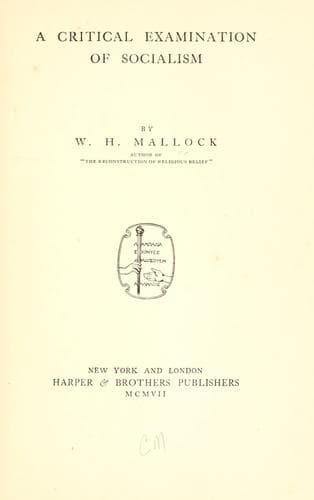
A Critical Examination of SocialismMallock, W. H. (William Hurrell)
Philosophy
A Critical Examination of Socialism
Mallock, W. H. (William Hurrell)
Communism; Socialism
And with regard to practical matters, and more especially the modern
production of wealth, the case is just the same. No one has illustrated
more luminously than Herbert Spencer himself the multitudinous character
of the knowledge which modern production necessitates; and no one has
insisted with more emphasis than he that one of the rarest faculties to
be met with among human beings is the faculty, as he expresses it, of
"apprehending assembled propositions in their totality." It would be
difficult to define better in equally brief language the intellectual
aspect of that composite mental equipment which distinguishes from
ordinary men the monopolists of business ability. It is precisely by
apprehending a multitude of assembled propositions in their
totality--mathematical, chemical, geological, geographical, and so
forth--by combining them for a definite purpose, and translating them
into a series of orders which organised labour can execute, that the
intellect of the able man gives efficiency to the industrial processes
of to-day. In addition, moreover, to his purely intellectual faculties,
he requires others which, in their higher developments, are no less
rare--namely, a quick discernment of popular wants as they arise or an
imagination which enables him to anticipate them, an instinctive insight
into character which enables him to choose best men as his subordinates,
promptitude to seize on opportunities, courage which is the soul of
promptitude, and finally a driving energy by which the whole of his
moral and intellectual mechanism is actuated. As for "the aggregate of
conditions out of which he has arisen," or the aggregate of conditions
which surround him, these are common to him and to every one of his
fellow-countrymen. They are a landscape which surrounds them all. But
aggregates of conditions could no more produce the results of which, as
Herbert Spencer admits, the able man is the proximate cause, unless the
able man existed and could be induced to cause them, than a landscape
could be photographed without a lens or a camera, or a great picture of
it painted in the absence of a great artist.
Public-domain text, read in full here on John Shaqi.
Reviews
Reviews
No reviews yet
Be the first to share your thoughts on this work.
Elsewhere in the archive
Join the Discussion
Join the discussion
Sign in to leave a comment or review.
Sign InorCreate an account