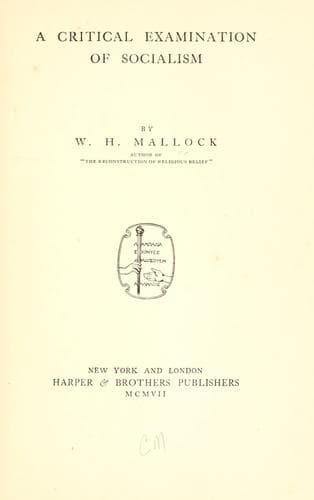
A Critical Examination of SocialismMallock, W. H. (William Hurrell)
Philosophy
A Critical Examination of Socialism
Mallock, W. H. (William Hurrell)
Communism; Socialism
Herbert Spencer, indeed, partially perceives all this himself. That is
to say, he realises from time to time that the causal importance of the
great man varies according to the nature of the problems in connection
with which we consider him and that while he is, for purposes of
general speculation, merely a transmitter of forces beyond and greater
than himself, he is for practical purposes an ultimate cause or fact.
That such is the case is shown in a curiously vivid way by two
references to two great men in particular, which occur not far from each
other in Spencer's _Study of Sociology_. One is a reference to the last
Napoleon, the other is a reference to the first. He refers to the former
when he is emphasising his main proposition, that the importance of the
ruler, considered as an individual, is small, and almost entirely merged
in the conditions of society generally. "If you wish," he says, "to
understand the phenomena of social evolution, you will not do it should
you read yourself blind over the biographies of all the great rulers on
record, down to Frederick the greedy and Louis Napoleon the
treacherous." When he makes his reference to Louis Napoleon's ancestor,
he is pausing for a moment in the course of his philosophical argument
in order to indulge in a parenthetical denunciation of war. Of the
insane folly of war, he says, we can have no better example than that
provided by Europe at the beginning of the nineteenth century, when
hardly a country was free from "slaughter, suffering, and devastation."
For what, he goes on to ask, was the cause of such wide-spread horrors?
Simply, he answers, the presence of one abnormal individual, "in whom
the instincts of the savage were scarcely at all qualified by what we
call moral sentiments"; and "all this slaughter, suffering, and
devastation" were, he says, "gone through because one man had a restless
desire to be despot over all men." Here we see how Spencer, as a matter
of common-sense, instinctively assigns to great men absolutely
contrasted positions, according to the point of view from which he is
himself regarding them--that of the speculative thinker and that of the
practical politician, and of this fact we will take one example more. Of
his doctrine that the great man is merely a "proximate initiator," and
in no true sense the cause of what he seems to produce or do, he gives
us an elaborate illustration taken from modern industry--that is to say,
the invention of the _Times_ printing-press. This wonderful piece of
mechanism would, he says, have been wholly impossible if it had not been
for a series of discoveries and inventions that had gone before it; and
having specified a multitude of these, winds up with a repetition of his
moral that of each invention individually the true cause is not the
so-called inventor, but "the aggregate of conditions out of which he has
arisen." But when elsewhere, in his treatise on _Social Statics_,
Public-domain text, read in full here on John Shaqi.
Reviews
Reviews
No reviews yet
Be the first to share your thoughts on this work.
Elsewhere in the archive
Join the Discussion
Join the discussion
Sign in to leave a comment or review.
Sign InorCreate an account