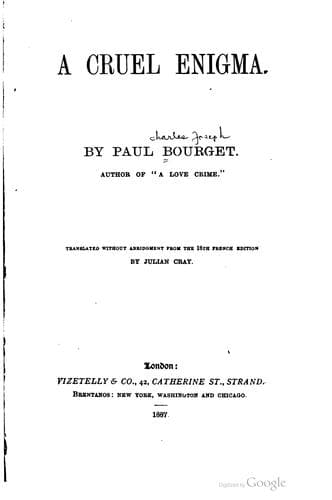
French fiction -- Translations into English; Love -- Fiction; Man-woman relationships -- Fiction
For most Parisian young men, such a scene would have been the prelude to
an effort towards the complete possession of a woman so evidently
smitten--an effort which might, perhaps, have miscarried; for a woman of
the world who wishes to protect herself finds many means, if she be
anything of a coquette, of avoiding a surrender, even after avowals of
the kind, or still more compromising marks of attachment. But there was
as little coquetry in the case of Madame de Sauve as there was physical
daring in that of the child of twenty-two who loved her. Did not these
two beings find themselves placed by chance in a situation of the
strangest delicacy? He was incapable of any further enterprise by reason
of his entire purity. As for her, how could she fail to understand that
to offer herself to him was to risk a diminution of his love? Such
difficulties are less rare under the conditions imposed upon the
feelings by modern manners than the fatuity of men will allow.
As manners are at present, all action between two persons who love each
other simultaneously becomes a sign, and how could a woman who knows
this fail to hesitate about compromising her happiness for ever by
seeking to embrace it too soon? Did Theresa obey this prudential motive,
or did she, perchance, find a heart's delight of delicious novelty in
the burning respect of her friend? With all men whom she had met before
this one, love had been only a disguised form of desire, and desire
itself an intoxicated form of self-pride. But whatever the reason might
be, she granted the young man all the meetings that he asked for during
the months following this first avowal, and all these meetings remained
as essentially innocent as they were clandestine.
While the Boulogne train was carrying Hubert towards the most longed-for
of these meetings he remembered the former ones--those passionate and
dangerous walks, nearly all hazarded across early Paris. They had in
this way adventured their ingenuous and guilty idyll in all the places
in which it seemed unlikely that anyone belonging to their set would
meet them. How many times, for instance, had they visited the towers of
Notre Dame, where Theresa loved to walk in her youthful grace amid the
old stone monsters carved on the balustrades? Through the slender ogive
windows of the ascent they looked alternately at the horizon of the
river confined between the quays, and that of the street confined
between the houses. In one of the buildings crouching in the shadow of
the cathedral, on the side of the Rue de Chanoinesse, there was a small
apartment on the fifth storey running out into a terrace, behind the
panes of which they used to imagine the existence of a romance similar
to their own, because they had twice seen a young woman and a young man
breakfasting there, seated at the same round table, with the window half
open.
Public-domain text, read in full here on John Shaqi.
Reviews
Reviews
No reviews yet
Be the first to share your thoughts on this work.
Join the Discussion
Join the discussion
Sign in to leave a comment or review.
Sign InorCreate an account