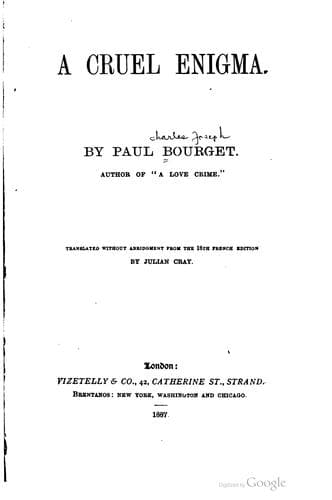
French fiction -- Translations into English; Love -- Fiction; Man-woman relationships -- Fiction
The boat is in the harbour; the passengers land and hurry to the train.
Hubert was almost the only one to halt in the little town. He allowed
his trunk to go on to London, and took his seat with his portmanteau in
one of the flies standing in front of the terminus. He had felt
something like a touch of melancholy when speaking to the driver and
thus ascertaining how correct and intelligible his English was,
notwithstanding that it was his first journey to England. He recalled
his childhood, his Yorkshire governess, his mother's care to make him
speak every day. If this poor mother were to see him now! Then these
memories were gradually effaced as the light vehicle, drawn by a pony at
a trot, briskly climbed the rude ascent by which the upper part of the
town is reached.
To the left of the young man stretched the wonderful landscape of the
sea, an immense gulf of pale green, blending in its extreme line with a
gulf of blue, and dotted all over with barques, schooners, and steamers.
On the summit the road turned.
The carriage left the cliff, entered a street, then a second, and then a
third, all lined with low houses, whose projecting windows showed rows
of red geraniums and ferns behind their panes. At a turning Hubert
perceived the door of a vast Gothic building and a black plate, the mere
inscription on which, in its gilt letters, made his heart leap. He found
himself in front of the Star Hotel. There was an interval for inquiring
at the office whether Madame Sylvie had arrived--this was the name that
Theresa had chosen to assume on account of the initials engraven on all
her toilet articles, and she was to have been entered in the books as a
dramatic artist; for ascending two storeys and passing down a long
corridor; then the servant opened the door of a small apartment, and
there, seated at a table in a drawing-room, the paleness of her face
increased by deep emotion, and her form clad in a garment of a red silky
material whose graceful folds outlined without accentuating her
figure,--there was Theresa. The coal fire glowed in the fireplace, the
inner sides of which were covered with coloured ware. A rotunda-like
window, of the kind that the English call "bow windows," was at the end
of the apartment, to which the furniture usual in such rooms in Great
Britain gave an aspect of quiet homeliness.
"Ah! it is really you," said the young man, going up to Theresa, who was
smiling at him, and he laid his hand upon his mistress's bosom as though
to convince himself of her existence. This gentle pressure enabled him
to feel beneath the slight material the passionate beatings of the happy
woman's heart.
"Yes, it is really I," she replied, with more languor than usual.
Public-domain text, read in full here on John Shaqi.
Reviews
Reviews
No reviews yet
Be the first to share your thoughts on this work.
Join the Discussion
Join the discussion
Sign in to leave a comment or review.
Sign InorCreate an account