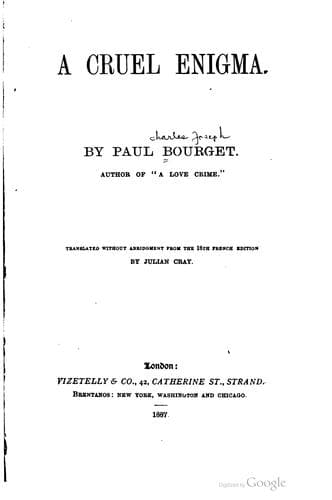
French fiction -- Translations into English; Love -- Fiction; Man-woman relationships -- Fiction
Truth to tell, he was not astonished by it for a moment. Two or three
times, indeed, on his way home, he repeated the words "Poor Hubert!" to
himself, but he secretly felt the mean and irresistible egotistic
titillation which is nine times out of ten produced by the sight of
other people's misfortunes. Were not his prognostications verified? And
this, too, was not devoid of a certain charm. Vulgar misanthropy has
many such satisfactions, which harden the heart that feels them. When a
man despises humanity with an indiscriminating contempt, he ends by
feeling satisfaction at its wretchedness, instead of being distressed by
it.
As for doubt, he did not admit it for a moment, especially when
recalling what he knew of Ludovic de la Croix-Firmin. The latter was a
species of coxcomb, who might, on reflection, appear to be devoid of any
superiority; but he was liked by women, for those mysterious reasons
which we men can no more understand than women can understand the secret
of the influence exercised over us by some of themselves. It is probable
that into these reasons there enters a good deal of that bestiality
which is always present at the bottom of our personal relations. La
Croix-Firmin was twenty-seven years old, the age of the fullest vigour,
with light hair bordering upon red, blue eyes, a clear complexion, and
teeth whose whiteness gleamed between a pair of very fresh lips at every
smile. When he smiled in this way, with his dimpled chin, his square
nose, and his curly locks, he recalled that type, immortal through the
races, of the countenance of Faunus, which the ancients made the
incarnation of happy sensuality.
To complete that quality of physical charm to which many fancies that he
had inspired were due, he had a suppleness of movement peculiar to those
in whom the vital force is very complete. He was of medium height, but
athletic. Although his ignorance was absolute and his intelligence very
moderate, he possessed the gift which renders a man of his make a
dangerous person; he had, in a rare degree, that tact and perception
which reveal the moment when a venture may be made, and when woman, a
creature of rapid moods and fleeting emotions, belongs to the libertine
who can divine it.
This La Croix-Firmin had had many intrigues, and, although his birth and
his future ought to have made him a perfect gentleman, he liked to
relate them; these indiscretions, instead of ruining him, served him, so
to speak, as advertisements. In spite of his light conversation and his
conceit, he had not made a single enemy among the women who had
compromised themselves for him; perhaps because he imaged to their
memories nothing but happy sensation--"'tis the material of the best
recollections," the cynics say, and, in respect of souls devoid of
loftiness, what can be more true?
Public-domain text, read in full here on John Shaqi.
Reviews
Reviews
No reviews yet
Be the first to share your thoughts on this work.
Join the Discussion
Join the discussion
Sign in to leave a comment or review.
Sign InorCreate an account