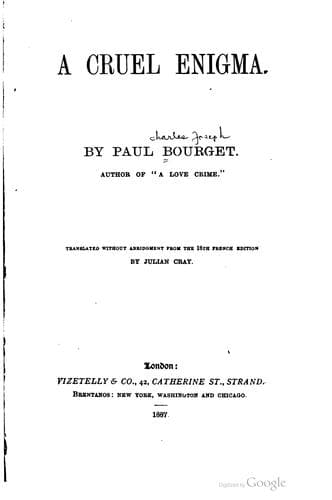
French fiction -- Translations into English; Love -- Fiction; Man-woman relationships -- Fiction
When paying his addresses to Theresa, he had the good sense not to lose
himself in the tricks of fashionable flirtations as did his numerous
rivals--a troop of beasts of prey on the scent of a victim. With great
skilfulness of language and a certain penetration of vice, he had
frankly offered to arrange with her a kind of partnership for pleasure
which should be secret, sure, and with no future, and the unfortunate
woman had accepted his proposal. Why? Because she was dreadfully dull;
because she was carrying off Suzel from one of her friends; because she
was greedy for new sensations, and this person, with his dishonouring
talk, had about him a sort of strange prestige of libertinism. Of this
connection, in which Frederick had at least been faithful to his promise
in not seeking to prolong it, Theresa had soon been deeply ashamed, and
she had escaped from it as from the galleys.
After a year spent in enduring her remorse, and in feeling herself
sullied by all the knowledge of evil that her intimacy with this man had
revealed to her, she had thought to find satisfaction for the needs of
her heart in the person of Alfred Fanières, one of the most subtle
novelists of the day. Did not all the books of this charming narrator,
from his first and only volume of poetry to his last collection of
tales, reveal the most minute and tender understanding of the gentle
feminine mind? In this second connection, begun with the most
intoxicating hope--that, namely, of consoling all the deceptions of an
admired artist--Theresa had soon struck upon the implacable barrenness
of the inmost nature of the worn-out literary man, in whom there is an
absolute divorce between feeling and written expression.
Though undeceived, she nevertheless persisted in remaining this man's
mistress, from that reason which causes a woman's second love affair to
be the longest of all in coming to a conclusion. She will admit that the
first has been a mistake; but the mistake of her marriage and the
mistake of her first amour make two; at the third error she acknowledges
that the fault in her conduct is due to herself, and not to the
circumstances of her life, and this is a cruel confession for secret
pride. Then the writer's egotism had manifested itself so harshly, when
he had believed himself sure of her, that the revolt had been too
strong, and Theresa had broken with him.
Public-domain text, read in full here on John Shaqi.
Reviews
Reviews
No reviews yet
Be the first to share your thoughts on this work.
Join the Discussion
Join the discussion
Sign in to leave a comment or review.
Sign InorCreate an account