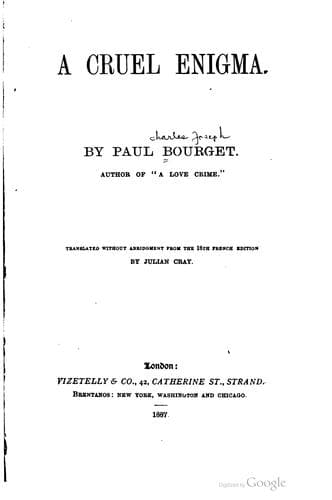
French fiction -- Translations into English; Love -- Fiction; Man-woman relationships -- Fiction
What then was Theresa doing, and how was it that she had essayed no
effort to see again the man she loved? What thoughts and what feelings
had she experienced since the terrible scene which had separated her
from Hubert? With her, too, days had succeeded to days, but while the
young man, a prey to a metamorphosis of soul provoked by the most
unlooked-for and tragic of deceptions, suffered these rapid burning days
to slip away as he passed from one extremity of the universe of feeling
to the other, she, the guilty one, the vanquished one, was absorbed in a
single thought. Herein like all women who love, she would have given her
blood-drops, one after another, to cure the sorrow that she had caused
to her lover. It was not that the visible details of her life were
modified. Except for the first week, during which she had been
overthrown, so to speak, by a continuous and shooting headache, she had,
as the result of a reaction from the experience of so many emotions,
resumed her vocation as a woman of fashion, her accustomed course of
drives and visits, great dinners and receptions, theatre-goings or
evening parties.
But this completely external movement has never been able to hinder
dreams any more than the employment of the needle does in fancy work.
Though a strange fact at first sight, the explanation in the Avenue
Friedland had been followed by a half-soothed relaxation in her soul,
simply because voluntary confession had lessened remorse, as it always
does. It is, too, on this unexplained law of our consciousness that the
subtle psychology of the Catholic Church has based the principle of
confession. If Theresa did not altogether forgive herself for her fault,
she was, at least, no longer compelled by her thoughts of it to endure
the contemplation of absolute baseness. The notion of a certain moral
loftiness was now associated with it, ennobling it in her own eyes. This
sleep of remorse left her free to absorb herself in the remembrance of
Hubert.
She now lived in a condition of deadly anxiety concerning him, and was
dominated by a steady longing to see him again, not that she hoped to
obtain her forgiveness from him, but she knew that he was unhappy, and
she felt within her such a love for the youth whom she had wounded, that
she would willingly have found means to dress and close the sore. How?
She could not have told that; but it was not possible that such great,
deeply-repentant tenderness could be inefficacious. In any case she
must, at least, show Hubert the scope of the passion which she felt for
him. Could this fail to touch him, to move him, to rescue him from
despair? Now that she was no longer beneath the immediate burden of her
infidelity, she did not judge of it from the essentially masculine
standpoint, that is, as being something absolute and irreparable.
Public-domain text, read in full here on John Shaqi.
Reviews
Reviews
No reviews yet
Be the first to share your thoughts on this work.
Elsewhere in the archive
Join the Discussion
Join the discussion
Sign in to leave a comment or review.
Sign InorCreate an account