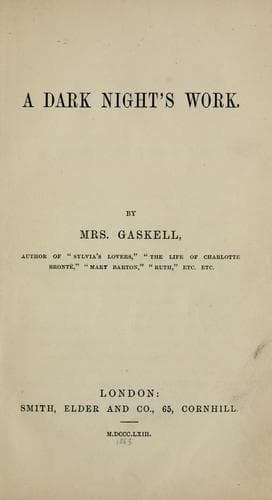
England -- Social life and customs -- 19th century -- Fiction
It was a very good straightforward letter and well fitted for the purpose
to which Mr. Wilkins knew it would be applied--of being forwarded to the
young man's father. One would have thought that it was not an engagement
so disproportionate in point of station as to cause any great opposition
on that score; but, unluckily, Captain Corbet, the heir and eldest son,
had just formed a similar engagement with Lady Maria Brabant, the
daughter of one of the proudest earls in ---shire, who had always
resented Mr. Wilkins's appearance on the field as an insult to the
county, and ignored his presence at every dinner-table where they met.
Lady Maria was visiting the Corbets at the very time when Ralph's letter,
enclosing Mr. Wilkins's, reached the paternal halls, and she merely
repeated her father's opinions when Mrs. Corbet and her daughters
naturally questioned her as to who these Wilkinses were; they remembered
the name in Ralph's letters formerly; the father was some friend of Mr.
Ness's, the clergyman with whom Ralph had read; they believed Ralph used
to dine with these Wilkinses sometimes, along with Mr. Ness.
Lady Maria was a goodnatured girl, and meant no harm in repeating her
father's words; touched up, it is true, by some of the dislike she
herself felt to the intimate alliance proposed, which would make her
sister-in-law to the daughter of an "upstart attorney," "not received in
the county," "always trying to push his way into the set above him,"
"claiming connection with the De Wintons of --- Castle, who, as she well
knew, only laughed when he was spoken of, and said they were more rich in
relations than they were aware of"--"not people papa would ever like her
to know, whatever might be the family connection."
These little speeches told in a way which the girl who uttered them did
not intend they should. Mrs. Corbet and her daughters set themselves
violently against this foolish entanglement of Ralph's; they would not
call it an engagement. They argued, and they urged, and they pleaded,
till the squire, anxious for peace at any price, and always more under
the sway of the people who were with him, however unreasonable they might
be, than of the absent, even though these had the wisdom of Solomon or
the prudence and sagacity of his son Ralph, wrote an angry letter, saying
that, as Ralph was of age, of course he had a right to please himself,
therefore all his father could say was, that the engagement was not at
all what either he or Ralph's mother had expected or hoped; that it was a
degradation to the family just going to ally themselves with a peer of
James the First's creation; that of course Ralph must do what he liked,
but that if he married this girl he must never expect to have her
received by the Corbets of Corbet Hall as a daughter. The squire was
rather satisfied with his production, and took it to show it to his wife;
but she did not think it was strong enough, and added a little postscript
"DEAR RALPH,
Public-domain text, read in full here on John Shaqi.
Reviews
Reviews
No reviews yet
Be the first to share your thoughts on this work.
Join the Discussion
Join the discussion
Sign in to leave a comment or review.
Sign InorCreate an account