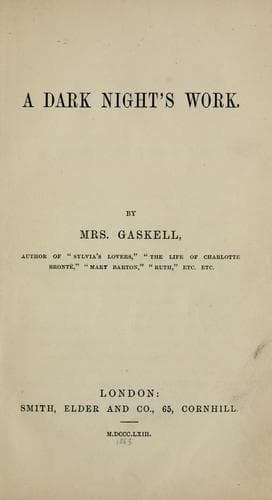
England -- Social life and customs -- 19th century -- Fiction
Some country people at work at the roadside, as the father and daughter
passed along, stopped to admire their bright happy looks, and one spoke
of the hereditary handsomeness of the Wilkins family (for the old man,
the present Mr. Wilkins's father, had been fine-looking in his drab
breeches and gaiters, and usual assumption of a yeoman's dress). Another
said it was easy for the rich to be handsome; they had always plenty to
eat, and could ride when they were tired of walking, and had no care for
the morrow to keep them from sleeping at nights. And, in sad
acquiescence with their contrasted lot, the men went on with their
hedging and ditching in silence.
And yet, if they had known--if the poor did know--the troubles and
temptations of the rich; if those men had foreseen the lot darkening over
the father, and including the daughter in its cloud; if Mr. Wilkins
himself had even imagined such a future possible . . . Well, there was
truth in the old heathen saying, "Let no man be envied till his death."
Ellinor had no more rides with her father; no, not ever again; though
they had stopped that afternoon at the summit of a breezy common, and
looked at a ruined hall, not so very far off; and discussed whether they
could reach it that day, and decided that it was too far away for
anything but a hurried inspection, and that some day soon they would make
the old place into the principal object of an excursion. But a rainy
time came on, when no rides were possible; and whether it was the
influence of the weather, or some other care or trouble that oppressed
him, Mr. Wilkins seemed to lose all wish for much active exercise, and
rather sought a stimulus to his spirits and circulation in wine. But of
this Ellinor was innocently unaware. He seemed dull and weary, and sat
long, drowsing and drinking after dinner. If the servants had not been
so fond of him for much previous generosity and kindness, they would have
complained now, and with reason, of his irritability, for all sorts of
things seemed to annoy him.
"You should get the master to take a ride with you, miss," said Dixon,
one day as he was putting Ellinor on her horse. "He's not looking well,
he's studying too much at the office."
But when Ellinor named it to her father, he rather hastily replied that
it was all very well for women to ride out whenever they liked--men had
something else to do; and then, as he saw her look grave and puzzled, he
softened down his abrupt saying by adding that Dunster had been making a
fuss about his partner's non-attendance, and altogether taking a good
deal upon himself in a very offensive way, so that he thought it better
to go pretty regularly to the office, in order to show him who was
master--senior partner, and head of the business, at any rate.
Public-domain text, read in full here on John Shaqi.
Reviews
Reviews
No reviews yet
Be the first to share your thoughts on this work.
Join the Discussion
Join the discussion
Sign in to leave a comment or review.
Sign InorCreate an account