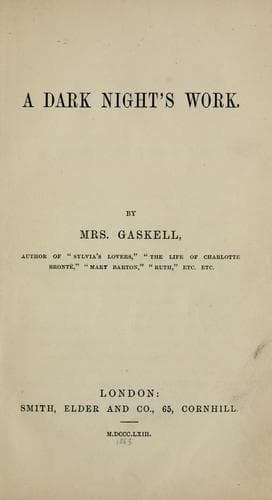
England -- Social life and customs -- 19th century -- Fiction
Edward was annoyed at all this; Lettice resented it. She loved her
husband dearly, and was proud of him, for she had discernment enough to
see how superior he was in every way to her cousins, the young Holsters,
who borrowed his horses, drank his wines, and yet had caught their
father's habit of sneering at his profession. Lettice wished that Edward
would content himself with a purely domestic life, would let himself drop
out of the company of the ---shire squirearchy, and find his relaxation
with her, in their luxurious library, or lovely drawing-room, so full of
white gleaming statues, and gems of pictures. But, perhaps, this was too
much to expect of any man, especially of one who felt himself fitted in
many ways to shine in society, and who was social by nature. Sociality
in that county at that time meant conviviality. Edward did not care for
wine, and yet he was obliged to drink--and by-and-by he grew to pique
himself on his character as a judge of wine. His father by this time was
dead; dead, happy old man, with a contented heart--his affairs
flourishing, his poorer neighbours loving him, his richer respecting him,
his son and daughter-in-law, the most affectionate and devoted that ever
man had, and his healthy conscience at peace with his God.
Lettice could have lived to herself and her husband and children. Edward
daily required more and more the stimulus of society. His wife wondered
how he could care to accept dinner invitations from people who treated
him as "Wilkins the attorney, a very good sort of fellow," as they
introduced him to strangers who might be staying in the country, but who
had no power to appreciate the taste, the talents, the impulsive artistic
nature which she held so dear. She forgot that by accepting such
invitations Edward was occasionally brought into contact with people not
merely of high conventional, but of high intellectual rank; that when a
certain amount of wine had dissipated his sense of inferiority of rank
and position, he was a brilliant talker, a man to be listened to and
admired even by wandering London statesmen, professional diners-out, or
any great authors who might find themselves visitors in a ---shire
country-house. What she would have had him share from the pride of her
heart, she should have warned him to avoid from the temptations to sinful
extravagance which it led him into. He had begun to spend more than he
ought, not in intellectual--though that would have been wrong--but in
purely sensual things. His wines, his table, should be such as no
squire's purse or palate could command. His dinner-parties--small in
number, the viands rare and delicate in quality, and sent up to table by
an Italian cook--should be such as even the London stars should notice
with admiration. He would have Lettice dressed in the richest materials,
the most delicate lace; jewellery, he said, was beyond their means;
glancing with proud humility at the diamonds of the elder ladies, and the
Public-domain text, read in full here on John Shaqi.
Reviews
Reviews
No reviews yet
Be the first to share your thoughts on this work.
Join the Discussion
Join the discussion
Sign in to leave a comment or review.
Sign InorCreate an account