She stepped within her open door and faced him. Her eyes blazed, her whole
attitude was that of defiance. The passions, which in well-bred women are
educated clean down out of sight, were in Maggie Promoter's tongue tip and
finger tips. Angus saw it would not do to anger her further, and he said,
"I meant nae harm, Maggie."
"I'll no answer you anither word. And mind what I told you. Dinna cross my
doorstane. You'll get the red face if you try it." She could have shut the
door, but she would have thought the act a kind of humiliation. She
preferred to stand guard at its threshold, until Angus, with a black scowl
and some muttered words of anger, walked away. She watched him until he
leaped into his boat; until he was fairly out to sea. Then she shut and
barred the door; and sitting down in her father's chair, wept
passionately; wept as women weep, before they have learned the uselessness
of tears, and the strength of self-restraint.
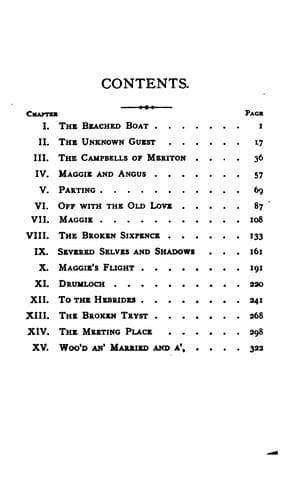
CHAPTER III.
THE CAMPBELLS OF MERITON.
"We figure to ourselves
The thing we like, and then we build it up
As chance will have it, on the rock or sand."
"About some act,
That has no relish of salvation in it."
Upon the shores of Bute, opposite the rugged, heathery hills of Cowal,
John Campbell had built himself a splendid habitation. People going up and
Down the Kyles were in the habit of pointing out Meriton Mansion, and of
asserting that the owner had risen from extreme poverty to his enviable
position. There was not a word of truth in this story. John Campbell was
the youngest son of Campbell of Drumloch, a gentleman of ancient lineage,
and of considerable wealth. Alexander, his elder son, inherited from him
the castle of Drumloch and the lands pertaining to the name and the
estate; to his younger son John he gave a large sum of money. With this
money he opened a shipping house on the Broomilaw of Glasgow, and
gradually built a fleet of trading vessels, which traversed every known
sea. John Campbell's name had indeed become synonymous for enterprise,
wealth and commercial honor.
The tie between the brothers was always an affectionate one; and when
Alexander died early in life, he left his child and the estate in charge
of John. The estate was much embarrassed, the child was a delicate girl of
nine years. But when ten years had passed the conditions of both were
changed; Mary Campbell had grown to a sweet and charming womanhood, and
Drumloch had paid off its last shilling of mortgage, and was as desirable
an estate as could be found in the west of Scotland.
Public-domain text, read in full here on John Shaqi.
Reviews
Reviews
No reviews yet
Be the first to share your thoughts on this work.
Join the Discussion
Join the discussion
Sign in to leave a comment or review.
Sign InorCreate an account