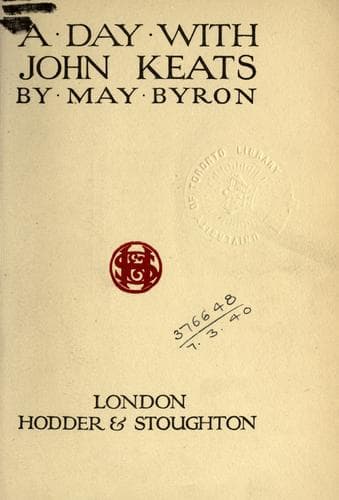
English poetry -- 19th century; Keats, John, 1795-1821
I met a lady in the meads
Full beautiful, a faery's child;
Her hair was long, her foot was light,
And her eyes were wild.
I set her on my pacing steed,
And nothing else saw all day long;
And sideways would she lean, and sing
A faery's song.
I made a garland for her head,
And bracelets too, and fragrant zone;
She look'd at me and she did love,
And made sweet moan.
She found me roots of relish sweet,
And honey wild, and manna dew;
And sure in language strange she said,
I love thee true.
She took me to her elfin grot,
And there she gaz'd and sighed deep,
And there I shut her wild sad eyes--
So kiss'd to sleep.
And there we slumber'd on the moss,
And there I dream'd, ah woe betide,
The latest dream I ever dream'd
On the cold hill side.
I saw pale kings, and princes too,
Pale warriors, death-pale were they all;
Who cried--"La belle Dame sans merci
Hath thee in thrall!"
I saw their starv'd lips in the gloam
With horrid warning gaped wide,
And I awoke, and found me here
On the cold hill side.
And this is why I sojourn here
Alone and palely loitering,
Though the sedge is wither'd from the lake,
And no birds sing.
_La Belle Dame sans merci._
And now he hears the voice of his Belle Dame ringing light across the
garden; while he sits here, a prey to every distress, she is gaily
gossiping with her next-door neighbour Brown. At once the unhappy Keats
is tormented by a thousand jealous fears. Fanny is transferring her
affection to Brown: of that he is quite certain. He rushes out: his
black looks banish the much-amused Brown, and very nearly produce an
immediate rupture between Fanny and himself. But after a few bitter
words, he permits himself to be reassured--or is it cajoled?--and tells
her, "I must confess that I love you the more, in that I believe you
have liked me for my own sake and for nothing else." The poor boy, from
a worldly point of view, has "nothing else" to offer.
The lovers' quarrel is over for the nonce. Visitors begin to drop in for
the evening; there is music and singing in Brown's little drawing room.
Keats is very fond of music, and can himself, though possessing hardly
any voice, "produce a pleasing musical effect." He will sit and listen
for hours to a sympathetic performer: but his ear, like all his faculties,
is abnormally sensitive: and a wrong note will drive him into a frenzy.
As the room grows fuller, he becomes restive. "The poetical character,"
he has observed, "is not itself--it has no character. When I am in a
room with people, the identity of everyone in the room begins to press
upon me so that I am in a little time annihilated."
Public-domain text, read in full here on John Shaqi.
Reviews
Reviews
No reviews yet
Be the first to share your thoughts on this work.
Join the Discussion
Join the discussion
Sign in to leave a comment or review.
Sign InorCreate an account