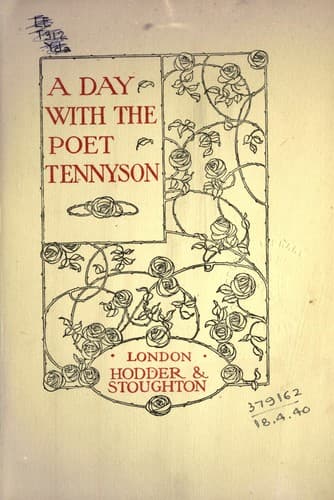
English poetry -- 19th century; Tennyson, Alfred Tennyson, Baron, 1809-1892
"I stretch lame hands of faith, and grope,
And gather dust and chaff, and call
To what I feel is Lord of all,
And faintly trust the larger hope."
_In Memoriam._
But these mysteries of life and death will not bear too persistent a
contemplation: and presently Tennyson, discarding them in favour of
less sombre subjects, would regale his hearers with marvellous
recitations. "The roll of his great voice acted sometimes almost like
an incantation." The old-world classical legends had always found in
him a noble exponent; and nowhere was his peculiar felicity of
diction and delicate sense of sound better exemplified than in
_OEnone_.
"'O mother Ida, many-fountain'd Ida,
Dear mother Ida, harken ere I die.
Hear me, O Earth, hear me, O Hills, O Caves
That house the cold crown'd snake! O mountain brooks,
I am the daughter of a River-God,
Hear me, for I will speak, and build up all
My sorrow with my song, as yonder walls
Rose slowly to a music slowly breathed,
A cloud that gather'd shape; for it may be
That, while I speak of it, a little while
My heart may wander from its deeper woe.
"'O mother Ida, many-fountain'd Ida,
Dear mother Ida, harken ere I die.
I waited underneath the dawning hills,
Aloft the mountain lawn was dewy-dark,
And dewy-dark aloft the mountain pine:
Beautiful Paris, evil-hearted Paris,
Leading a jet-black goat white-horn'd, white-hooved,
Came up from reedy Simois all alone.
* * * * *
"Dear mother Ida, harken, ere I die.
He smiled, and opening out his milk-white palm
Disclosed a fruit of pure Hesperian gold,
That smelt ambrosially, and while I look'd
And listen'd, the full-flowing river of speech
Came down upon my heart.
'My own OEnone,
Beautiful-brow'd OEnone, my own soul,
Behold this fruit, whose gleaming rind ingrav'n,
'For the most fair,' would seem to award it thine,
As lovelier than whatever Oread haunt
The knolls of Ida, loveliest in all grace
Of movement, and the charm of married brows.'
"Dear mother Ida, harken ere I die.
He prest the blossom of his lips to mine,
And added, 'This was cast upon the board,
When all the full-faced presence of the Gods
Ranged in the halls of Peleus; whereupon
Rose feud, with question unto whom 'twere due:
"'But light-foot Iris brought it yester-eve,
Delivering, that to me, by common voice
Elected umpire, Herè comes to-day,
Pallas and Aphroditè, claiming each
This meed of fairest. Thou, within the cave
Behind yon whispering tuft of oldest pine,
Mayst well behold them, unbeheld, unheard
Hear all, and see thy Paris judge of Gods.'
Public-domain text, read in full here on John Shaqi.
Reviews
Reviews
No reviews yet
Be the first to share your thoughts on this work.
Join the Discussion
Join the discussion
Sign in to leave a comment or review.
Sign InorCreate an account