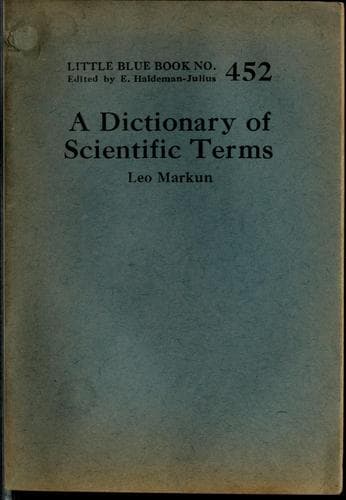
LITTLE BLUE BOOK NO. 452
Edited by E. Haldeman-Julius
A Dictionary of
Scientific Terms
Leo Markun
HALDEMAN-JULIUS PUBLICATIONS
GIRARD, KANSAS
Copyright, 1927
Haldeman-Julius Company
PRINTED IN THE UNITED STATES OF AMERICA
A DICTIONARY OF SCIENTIFIC TERMS
PREFACE
Completeness is a virtue which this little Blue Book cannot, in the
nature of things, possess. If any reader is disappointed not to find it
here, I must respectfully direct his attention to the three ponderous
tomes which make up a well-known dictionary of chemistry, to the still
larger and more numerous volumes devoted to a dictionary of applied
physics, and to other similar works. The sciences are many, and the
words which they employ exclusively or in senses peculiar to themselves
are exceedingly numerous.
Physics, chemistry, and biology contribute the greatest number of
words to the present dictionary. A few terms used in other sciences
are included, chiefly to show what I believe the proper scope of a
dictionary of scientific terms to be. There is a genuine need for a
large dictionary, which ought to be of about the same size as Webster’s
Collegiate or the Oxford Concise, and which should deal with the
vocabularies of economics, anthropology, sociology, and psychology as
well as with those of mechanics, geology, astronomy, and all the older
sciences. Such a dictionary should be written by specialists in the
various fields of knowledge with the aid of a skilled etymologist, and
under the supervision of an editor who is not himself a professional
scientist. It would be his special task to see that the definitions
are intelligible to non-specialists, and to literate laymen in
particular.
Of course no dictionary can take the place of primers of the sciences.
There are a number of excellent ones in this series, some of which I
referred to in writing this book. It is in many cases impossible to
give adequate explanations in a few words. Besides, the scientific
writers themselves frequently quarrel about the true meaning of such a
word as _ether_ or _instinct_.
I have dealt here with a number of words which are of significance when
we try to set the limits of science. _Common sense_, _philosophy_,
_theology_, and _superstition_ are examples. The claims of several
branches of knowledge to be considered sciences are also taken up.
A DICTIONARY OF SCIENTIFIC TERMS
_Abasia._ The inability to walk, especially when it is caused by mental
disorder.
_Abdomen._ The hind part of insects, spiders, etc. The belly, including
the nutritive organs.
_Aberrant._ Diverging from normal type.
_Aberration._ The non-convergence of rays of light to a focus. The
apparent displacement of the true position of a heavenly body.
_Abiogenesis._ Spontaneous generation.
Public-domain text, read in full here on John Shaqi.
Reviews
Reviews
No reviews yet
Be the first to share your thoughts on this work.
Join the Discussion
Join the discussion
Sign in to leave a comment or review.
Sign InorCreate an account