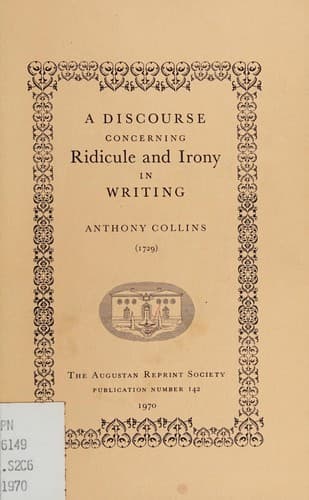
A discourse concerning ridicule and irony in writing (1729) — John Shaqi
A discourse concerning ridicule and irony in writing (1729)Collins, Anthony
Religion
A discourse concerning ridicule and irony in writing (1729)
Collins, Anthony
Satire
Our Clergy have ever treated Mr. _Hobbes_ with the greatest Mockery,
Ridicule and Raillery: As for example, _Ward_ Bishop of _Sarum_, _Brambal_
Bishop of _Derry_, _Parker_ Bishop of _Oxford_, Dr. _Wallis_ in his
several bantering Treatises against him, _Lucy_ Bishop of _St. Davids,
Shafto_, and particularly the Reverend _Droll_, Dr. _Eachard_, in two
_Dialogues_, which, it is well known, have been universally well receiv'd
by the Clergy, and that for their Treatment of Mr. _Hobbes_ in the
ridiculing Way; for which the Author himself makes the following just
Apology, in his _Dedication_ of his _Second Dialogue_ to Archbishop
_Sheldon_, "That of all Triflers, 'tis the _Set_, the _Grave_, the
_Philosophical_, and the _Mathematical Trifler_, to which he has the
greatest Aversion; whom when he meets, very gravely making out all Men to
be rational Beasts both in Nature and Conversation, and every Man, he
pleases, a rational Rebel; and upon any Fright or Pinch a rational Atheist
and Anti-Christian; and all this perform'd with all DEMURENESS, SOLEMNITY,
QUOTATION of SCRIPTURE, APPEALS to CONSCIENCE and CHURCH-HISTORY; he must
humbly beg his _Grace's_ Pardon, if then he has endeavour'd to SMILE a
little, and to get as much out of his Road and way of Writing as
possible." These _Dialogues_ used to be much recommended to the Youth to
make them laugh at Mr _Hobbes_, who was constantly represented as
provok'd and put out of all Temper by them, and was said to have vented
this strange and impious Expression, upon its being told him, that _the
Clergy said_ Eachard _had crucify'd_ Hobbes; "Why then don't they fall
down and worship me?"
Mr. _Selden_ has been the constant Subject of Clergy-banter, for his
_History of Tythes_; in the _Preface_ to which, "He reproaches the Clergy
with Ignorance and Laziness, and upbraids them with having nothing to keep
up their Credit but _Beard_, _Title_, and _Habit_; and their Studies
reach'd no farther than the _Breviary_, the _Postils_, and _Polyanthea_."
For this Work he was attack'd more particularly by three Divines,
_Tillesly_, _Mountagu_, and _Nettles_. And their Success was thus
originally represented[47], "That he was so gall'd by _Tillesly_, so
gagg'd by _Mountagu_, and so stung by _Nettles_, that he never came off in
any of his Undertakings with more loss of Credit." And this Jest has
pass'd much upon the World, and been continued down in many Books, where
Mr. _Selden_ is mention'd, to his Discredit with ignorant Readers, but not
with the Knowing and Learned; who, as Dr. _Wotton_ tells us[48], _have,
now Party-heats are over, acquiesced in what Mr._ Selden advanc'd; _who
first_, OF ALL CHRISTIANS, _set the Affair_ of Tythes _in a clear Light_.
It is usually said the Comedy called _Ignoramus_, which is a Clergy-banter
upon the _Law_, was a design'd Return for Mr. _Selden_'s _History of
Tythes_.
Public-domain text, read in full here on John Shaqi.
Reviews
Reviews
No reviews yet
Be the first to share your thoughts on this work.
Join the Discussion
Join the discussion
Sign in to leave a comment or review.
Sign InorCreate an account