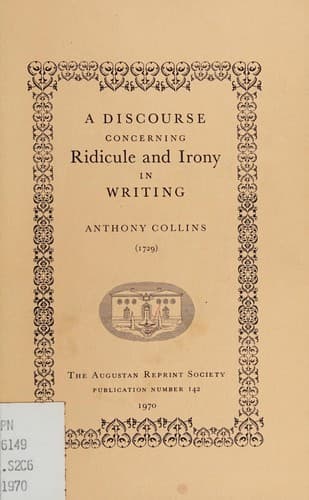
A discourse concerning ridicule and irony in writing (1729)Collins, Anthony
Religion
A discourse concerning ridicule and irony in writing (1729)
Collins, Anthony
Satire
Early in 1727 the Anglican establishment came to the abrupt realization
that the subject of the continuing debate--the reliability of the argument
from prophecy--was inconclusive, that it could lead only to pedantic
wrangling and hair-splitting with each side vainly clutching victory.
Certainly the devotion of many clergymen to biblical criticism was
secondary to their interest in orthodoxy as a functional adjunct of
government, both civil and canonical. It was against this interest, as it
was enunciated in Rogers's _Eight Sermons concerning the Necessity of
Revelation_ (1727) and particularly in its vindictive preface, that
Collins chose to fight.[7] The debate had now taken a happy turn for him.
As he saw it, the central issue devolved upon man's natural right to
religious liberty. At least he made this the theme of his _Letter to Dr.
Rogers_. In writing to Des Maizeaux about the success of this work, he
obviously enjoyed his own profane irony:
I have had particular compliments made me by the BP of Salisbury,
and by Dr Clark, who among other things sayd, that the Archbp of
Canterbury might have writ all that related to Toleration in it: to
say nothing of what I hear from others. Dr Rogers himself has
acknowledg[ed] to his Bookseller who sent it to him into the Country,
that he has receivd it; but says that he is so engaged in other
affairs, that he has no thought at present of answering it; tho he
may perhaps in time do so.[8]
In time Rogers did. He counterattacked on 2 February 1728 with a
_Vindication of the Civil Establishment of Religion_.[9] For Collins this
work was a dogged repetition of what had gone before, and so it could be
ignored except for one of its appendices, _A Letter from the Rev. Dr.
Marshall jun. To the Rev. Dr. Rogers, upon Occasion of his Preface to his
Eight Sermons_. Its inclusion seemed an afterthought; yet it altered the
dimensions of the debate by narrowing and particularizing the areas of
grievance which separated the debaters. Collins, therefore, rebutted it
some fourteen months later in _A Discourse concerning Ridicule and Irony
in Writing_. He had great hopes for this pamphlet, preparing carefully for
its reception. He encouraged the republication of his three preceding
works, which find their inevitable conclusion, even their exoneration, in
this last performance, and he probably persuaded his bookseller to
undertake an elaborate promotional campaign. For the new editions were
advertised on seven different days between 10 January and 27 February 1729
in the _Daily Post_. He wanted no one to miss the relationship between the
_Discourse concerning Ridicule and Irony_ and these earlier pieces or to
overlook its presence when it finally appeared in the pamphlet shops on 17
March.
Public-domain text, read in full here on John Shaqi.
Reviews
Reviews
No reviews yet
Be the first to share your thoughts on this work.
Join the Discussion
Join the discussion
Sign in to leave a comment or review.
Sign InorCreate an account