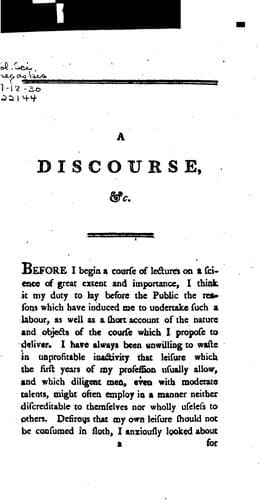
A Discourse on the Study of the Law of Nature and NationsMackintosh, James, Sir
Philosophy
A Discourse on the Study of the Law of Nature and Nations
Mackintosh, James, Sir
International law; Natural law
But this is no place for discussions of taste, and I am very ready to
own that mine may be corrupted. The work of Grotius is liable to a more
serious objection, though I do not recollect that it has ever been made.
His method is inconvenient and unscientific. He has inverted the natural
order. That natural order undoubtedly dictates, that we should first
search for the original principles of the science in human nature; then
apply them to the regulation of the conduct of individuals, and lastly,
employ them for the decision of those difficult and complicated
questions that arise with respect to the intercourse of nations. But
Grotius has chosen the reverse of this method. He begins with the
consideration of the states of peace and war, and he examines original
principles only occasionally and incidentally as they grow out of the
questions which he is called upon to decide. It is a necessary
consequence of this disorderly method, which exhibits the elements of
the science in the form of scattered digressions, that he seldom employs
sufficient discussion on these fundamental truths, and never in the
place where such a discussion would be most instructive to the reader.
This defect in the plan of Grotius was perceived, and supplied, by
Puffendorff, who restored natural law to that superiority which belonged
to it, and with great propriety treated the law of nations as only one
main branch of the parent stock. Without the genius of his master, and
with very inferior learning, he has yet treated this subject with sound
sense, with clear method, with extensive and accurate knowledge, and
with a copiousness of detail sometimes indeed tedious, but always
instructive and satisfactory. His work will be always studied by those
who spare no labour to acquire a deep knowledge of the subject; but it
will, in our times, I fear, be oftener found on the shelf than on the
desk of the general student. In the time of Mr. Locke it was considered
as the manual of those who were intended for active life; but in the
present age I believe it will be found that men of business are too much
occupied, men of letters are too fastidious, and men of the world too
indolent, for the study or even the perusal of such works. Far be it
from me to derogate from the real and great merit of so useful a writer
as Puffendorff. His treatise is a mine in which all his successors must
dig. I only presume to suggest, that a book so prolix, and so utterly
void of all the attractions of composition, is likely to repel many
readers who are interested, and who might perhaps be disposed to
acquire some knowledge of the principles of public law.
Public-domain text, read in full here on John Shaqi.
Reviews
Reviews
No reviews yet
Be the first to share your thoughts on this work.
Join the Discussion
Join the discussion
Sign in to leave a comment or review.
Sign InorCreate an account