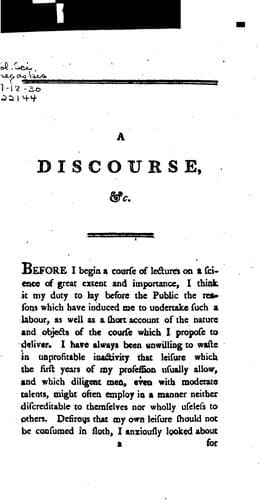
A Discourse on the Study of the Law of Nature and NationsMackintosh, James, Sir
Philosophy
A Discourse on the Study of the Law of Nature and Nations
Mackintosh, James, Sir
International law; Natural law
I. The being whose actions the law of nature professes to regulate, is
man. It is on the knowledge of his nature that the science of his duty
must be founded.[15] It is impossible to approach the threshold of moral
philosophy, without a previous examination of the faculties and habits
of the human mind. Let no reader be repelled from this examination, by
the odious and terrible name of _metaphysics_; for it is, in truth,
nothing more than the employment of good sense, in observing our own
thoughts, feelings, and actions; and when the facts which are thus
observed, are expressed as they ought to be, in plain language, it is,
perhaps, above all other sciences, most on a level with the capacity and
information of the generality of thinking men. When it is thus
expressed, it requires no previous qualification, but a sound judgment,
perfectly to comprehend it; and those who wrap it up in a technical and
mysterious jargon, always give us strong reason to suspect that they are
not philosophers but impostors. Whoever thoroughly understands such a
science, must be able to teach it plainly to all men of common sense.
The proposed course will therefore open with a very short, and, I hope,
a very simple and intelligible account of the powers and operations of
the human mind. By this plain statement of facts, it will not be
difficult to decide many celebrated, though frivolous, and merely verbal
controversies, which have long amused the leisure of the schools, and
which owe both their fame and their existence to the ambiguous obscurity
of scholastic language. It will, for example, only require an appeal to
every man's experience, to prove that we often act purely from a regard
to the happiness of others, and are therefore social beings; and it is
not necessary to be a consummate judge of the deceptions of language,
to despise the sophistical trifler, who tells us, that, because we
experience a gratification in our benevolent actions, we are therefore
exclusively and uniformly selfish. A correct examination of facts will
lead us to discover that quality which is common to all virtuous
actions, and which distinguishes them from those which are vicious and
criminal. But we shall see that it is necessary for man to be governed
not by his own transient and hasty opinion upon the tendency of every
particular action, but by those fixed and unalterable rules, which are
the joint result of the impartial judgment, the natural feelings, and
the embodied experience of mankind. The authority of these rules is,
indeed, founded only on their tendency to promote private and public
welfare; but the morality of actions will appear solely to consist in
their correspondence with the rule. By the help of this obvious
distinction we shall vindicate a just theory, which, far from being
modern, is, in fact, as ancient as philosophy, both from plausible
objections, and from the odious imputation of supporting those absurd
and monstrous systems which have been built upon it.
Public-domain text, read in full here on John Shaqi.
Reviews
Reviews
No reviews yet
Be the first to share your thoughts on this work.
Join the Discussion
Join the discussion
Sign in to leave a comment or review.
Sign InorCreate an account