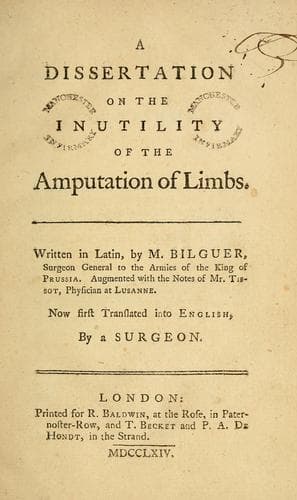
A dissertation on the inutility of the amputation of limbsBilguer, Johann Ulrich
History
A dissertation on the inutility of the amputation of limbs
Bilguer, Johann Ulrich
Amputation -- Early works to 1800
The following embrocations applied to parts already mortified, will
stop the further progress of the mortification; where it is just
beginning they will prevent it, and will also help nature to separate
the dead parts from the sound.
1. _Spirit of wine, three ounces; myrrh and aloes powdered, of each
half an ounce; Ægyptian ointment, three drams[12]._
2. _Vinous decoction of scordium, twelve ounces; vinegar of rue and of
roses, of each four ounces; spirit of treacle, three ounces; and one
ounce of sal ammoniac._
3. _Lime water, four pints; treacle spirit, or that of feverfew, two
pints; white wine vinegar, one pint; elixir proprietatis, six ounces;
Ægyptian ointment, two ounces._
4. _Decoction of elder flowers, six ounces; wine, eight ounces;
vinegar, camphorated spirit of wine, treacle spirit, or that of
feverfew, each two ounces; spirit of salt, two drams._
Lastly, in order to soften the parts, separate the sloughs, and promote
suppuration, the following application may be used.
_Water germander, two handfulls; mallows and marshmallows, each
a handfull; flower of linseed, three ounces; Venice soap and sal
ammoniac, of each two ounces; linseed oil, an ounce. Let these
ingredients be boiled together, in vinegar and water, to the
consistence of a poultice._
It may be in general observed with regard to fomentations, that such
as are emollient are serviceable, when hard dry crusts prevent a
discharge; those which abound with acid, when there is a considerable
degree of putrefaction; and, lastly, those which are spirituous, saline
or strengthening, are most proper when swellings are flabby, and the
body abounds with aqueous humours.
FOOTNOTES:
[9] These two last applications are not in Heister: The _species
pro cataplasmatic_, consists of _yarrow, wormwood, water germander,
southernwood, chamomile, sage, hysop, rue, elder, St. John's wort, and
red roses_.
It is quite unnecessary to make use of all these ingredients at one
time. TISSOT.
[10] As the composition of the martial ball may not be generally known,
I shall describe it in this place: _Take of filings of iron one part;
white tartar two parts: Let them be reduced to a fine powder, and put
into a matrass with as much French brandy as will swim about an inch
above the powder; exhale to dryness, either in the heat of the sun or
in that of a water bath. Pour fresh brandy upon the remainder, and
evaporate them in this manner several times successively, till the mass
appears resinous; then form it into balls nearly of the bigness of an
egg._
I do not exactly know what quantity Mr. Bilguer means by _sextarius_;
that measure, among the ancients, contained twenty four ounces, but
here I believe it denotes somewhat less. If we suppose it to be about a
pint, the medicine will be extremely good.
[11] This composition is commonly called _species pro decocto nigro_,
or the species for the black decoction.
Public-domain text, read in full here on John Shaqi.
Reviews
Reviews
No reviews yet
Be the first to share your thoughts on this work.
Join the Discussion
Join the discussion
Sign in to leave a comment or review.
Sign InorCreate an account