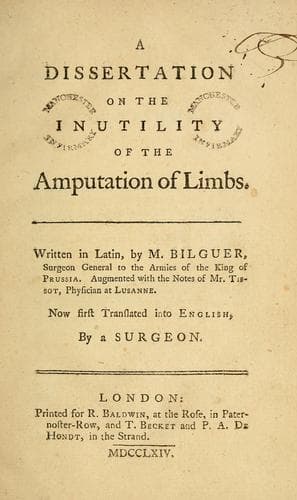
A dissertation on the inutility of the amputation of limbsBilguer, Johann Ulrich
History
A dissertation on the inutility of the amputation of limbs
Bilguer, Johann Ulrich
Amputation -- Early works to 1800
I shall treat at present of large contusions of the limbs, especially
of those where the fleshy parts, as well as the bones, are extremely
bruised and shattered, as commonly happens, when the hand, the foot,
the elbow, the leg, arm or thigh, have been bruised by a large stone,
a beam of wood, a cart-wheel, a screw, a press, &c. In such cases,
shall the patient get sooner well by amputating or not amputating this
shattered limb? I answer, by not amputating; the worst consequences
that can be apprehended, is a mortification or an hemorrhage. With
regard to the mortification, unless every thing I have hitherto said
concerning it be intirely groundless, we ought not to be afraid of
it; and it is much easier to prevent than to cure it. With respect
to the hemorrhage, it is no doubt to be dreaded, but this dread can
be no reason for instantly taking off the limb: To be convinced of
this, we need only examine those wounded men who have had an arm or
leg carried off by a ball, and the stump so shattered, that the bone
has been shivered into several pieces, and the large blood vessels
most shockingly torn, who have, notwithstanding, been cured without
amputation, and with whom the bleeding has stopt, even without the
assistance of a surgeon. Nevertheless, every body knows that contusions
of this kind have been hitherto, by most surgeons, accounted a
sufficient cause for amputation; and that when the hand or foot have
been shattered, they have carried their inhumanity so far, as to take
off, not only the leg or fore-arm, but even sometimes above the knee or
joint of the elbow.
Those who follow this method, amputate within a few days of the
accident, while the patient is vigorous, and without waiting for the
event of any other kind of treatment; for if the patient be weak, old
or very ill, even with the consequences of the wound, they do not
venture upon the operation.
It would however, in my opinion, be much better not only not to take
off an arm, a thigh, or a leg, which are unhurt, but even to endeavour
to save the foot or hand which are shattered, in obviating, by medicine
and diet, as well as by external applications, the accidents that may
ensue; and thus prevent a person who has already suffered so severely,
from meeting with a treatment still more severe.
It will be asked, if the thing be possible? The following observations
will furnish an answer. I publish them with so much the more
confidence, as they are known, not only by the patients themselves, but
by a great number of the physicians and surgeons of the army. They must
be decisive in favour of preserving contused and shattered limbs, in
opposition to amputation.
SECT. XXI.
Public-domain text, read in full here on John Shaqi.
Reviews
Reviews
No reviews yet
Be the first to share your thoughts on this work.
Join the Discussion
Join the discussion
Sign in to leave a comment or review.
Sign InorCreate an account