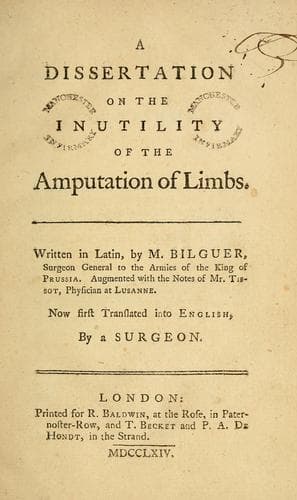
A dissertation on the inutility of the amputation of limbsBilguer, Johann Ulrich
History
A dissertation on the inutility of the amputation of limbs
Bilguer, Johann Ulrich
Amputation -- Early works to 1800
With respect to the larger fragments, which must form the stump of the
bone, I not only take care not to loosen them, but even, as I already
remarked, endeavour to promote their coalition, by light compression
with the hands, and binding the bandage somewhat tighter than I would
otherwise do. If, at the expiration of a month, a fragment of this
kind is not coalesced, but on the contrary, is become more loose,
without however being intirely so; in that case, by shaking it gently,
moving it upwards and downwards, and loosening the fleshy parts that
hold it, I endeavour to bring it away intirely. If there are some of
them cracked as high as the articulation, I give myself no concern
about them, but leave them to nature[21]. But as to the small, short,
pointed shivers which do not re-unite with the bone, I take care, as
I have already observed, to remove them as soon as possible, commonly
in the first seven or eight dressings; and at each dressing, I gently
stroke down the muscular flesh towards the end of the stump; I keep
the whole firm, by giving a proper degree of tightness to the bandage;
moistening it, as long as the dressings are necessary, two or three
times a day with spirit of wine. By these means, such kind of patients,
at the end of four or five months, are as compleatly cured as the
nature of the accidents will admit of.
FOOTNOTES:
[21] Felix Wurz and Gœuey cured, as may be seen in Heister's Surgery,
t. 1. p. 183. the longitudinal fissures of the bone, by a suitable
dressing, which is mentioned in the same place. If it should happen,
what I have never yet had an opportunity of seeing, that the bone
was split longitudinally as far as the joint, and that it appeared
impossible to procure its coalition by means of proper dressings, I
would make, taking care to avoid the blood vessels, two incisions, from
the extremity of the stump to the joint, that should go as deep as the
bone, and whose distance must depend on the breadth of the splinter to
be extracted. I would raise up from the bone the flesh included between
the two incisions, with a scalpel or myrtle-leaf, avoiding to hurt the
blood vessels as much as possible; then, having detached the splinter,
by means of the scalpel, from its adhesion with the ligaments of the
joint, I would bring it away.
If the hemorrhage were considerable, before I extracted the bone, I
would tie the vessels of the fleshy part which adhered to it; and after
having removed the bone, I would undo the ligatures, restore the flesh
to its place, take care of the small wounds made by the needles, and
would dress the whole part in the manner already mentioned in this
section.
SECT. XXII.
Besides what I have already said, I must further add some other useful
remarks.
Public-domain text, read in full here on John Shaqi.
Reviews
Reviews
No reviews yet
Be the first to share your thoughts on this work.
Join the Discussion
Join the discussion
Sign in to leave a comment or review.
Sign InorCreate an account