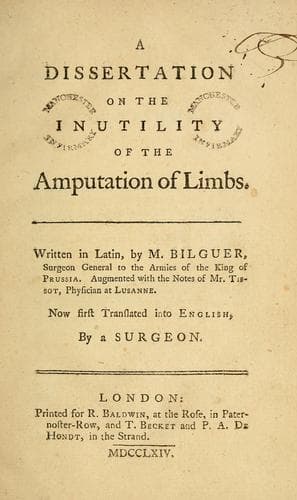
A dissertation on the inutility of the amputation of limbsBilguer, Johann Ulrich
History
A dissertation on the inutility of the amputation of limbs
Bilguer, Johann Ulrich
Amputation -- Early works to 1800
This work contains a much greater variety of matter than its title
implies, for it not only shews the inutility and danger of amputation,
by several arguments, to which many others might be added; but not
satisfied with levelling a tottering edifice, Mr. Bilguer frames and
describes a plan for preventing and curing those accidents, which
oblige surgeons to have recourse to amputation; and this is properly
the most considerable and most essential part of the performance, which
is, in fact, a treatise on gunshot wounds.
I have scarcely done Mr. Bilguer justice with regard to style: I
hope, however, I have given his meaning, without depriving it of its
perspicuity or strength. This work will begin a new æra in Surgery, and
will reach posterity. I should have been sorry in any shape to have
disfigured it.
It will give me very great pleasure, if the pains I have taken, and the
notes I have added, prove agreeable to the author. He may be convinced
that, being engaged in business as I am, his performance must have
appeared to me extremely well executed, and much wanted, before I
undertook to translate it.
I am informed he has lately published a work on Surgery, in the German
language; I am persuaded it contains much valuable matter: He seems
to me to have a genius for discovering new expedients to lessen the
sufferings of human kind. I would have given this book the title of a
_Manual for the Surgeons of the Army_, which it deserves to be, were
there not already another so called[1], which, although very little
known, is by no means contemptible. The author had, even at that time,
remarked that wounds of the tendons are not troublesome, owing to
their want of sensibility, that the actual cautery is seldom proper;
and some other facts, almost forgotten since that time. He describes
wounds near the articulations with dislocation and fracture, he points
out the accidents attending gunshot wounds, and, what deserves notice,
he only admits of amputation in one case; namely, that of an incurable
mortification, and mentions it as a cruel and doubtful expedient. I
shall here cite his own words; they plainly shew that, if he lived in
our time, he would be one of the most zealous encouragers of the new
method, since he was so sensible of the defects, and grieved at the
barbarity of the old. “If, unfortunately,” says he, “a mortification,
from whatever cause it proceeds, gains ground in such a manner as
to baffle all our care and applications, there is then no expedient
left but that of taking off the limb; the success of which is very
uncertain, for if it be dubious in a healthful subject, it must be
much more so in one which is otherwise: It is, however, the only
method, dreadful as it is, of putting astop to the ailment, and saving
the rest of the body. This nevertheless ought not to be done, except
when the consent, age and strength of the patient permit us to try so
dangerous an experiment.”
Public-domain text, read in full here on John Shaqi.
Reviews
Reviews
No reviews yet
Be the first to share your thoughts on this work.
Join the Discussion
Join the discussion
Sign in to leave a comment or review.
Sign InorCreate an account