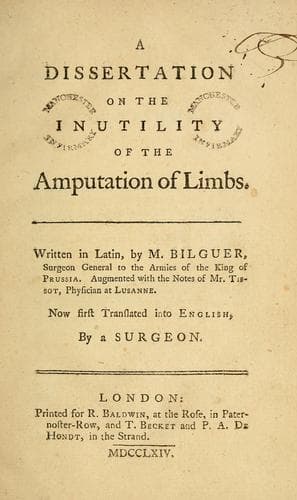
A dissertation on the inutility of the amputation of limbsBilguer, Johann Ulrich
History
A dissertation on the inutility of the amputation of limbs
Bilguer, Johann Ulrich
Amputation -- Early works to 1800
There are physical reasons that induce us to believe that the case
is so, and there are several observations which seem to confirm it.
Those who have served in time of war, have all been witnesses of some
singular instance or other of the effects of the percussion of the
air; there are instances of people killed on the field, without being
touched by the ball. I was told by officers, men of veracity, that at
the battle of Fontanoy, a ball broke the thigh bone of a soldier in the
Dutch army, without touching him; another saw a man who was rendered
paralytic on one side, by a ball whizing past him. Curious observers
know, that nothing so greatly fatigues an army as a high wind, even
the centinels are tired, without marching; the reason is, that a high
wind occasions a kind of general contusion, which of course produces
weariness. I do not know but some of the effects of lightening may be
imputed to the same cause. I shall add nothing to what Mr. Bilguer says
concerning the effects of a contusion; he is sufficiently explicit on
this head; and as I have already treated the subject pretty largely in
my book termed _Advice to the People_, I shall only observe, that in
the wounds made by musket-ball, the effect of the general concussion
is not very considerable, but the danger, in such cases, proceeds from
the topical contusion accompanying the wound, the small quantity of
blood commonly discharged from it; and lastly, as Mr. Le Dran remarks,
because the instant a man receives a gunshot wound, he is struck with a
sudden dread he cannot possibly resist. There seems to me to be three
reasons for this dread, of which even the wounded person himself is not
altogether conscious; in the first place, the idea that gunshot wounds
are dangerous; secondly, because the degree of the hurt is not known;
thirdly, the instantaneous effect of the concussion, which renders
a man much more susceptible of fear. There is a point of time when
courage is useless. I shall beg leave, in this place, to insert a case
I had from the eye-witnesses, and which demonstrates the bad effect
of apprehension on wounded patients. Two officers, in the service of
France, were wounded in the last campaign but one; one of them very
dangerously, the other, who had been a prisoner a little time before,
and had been extremely ill used, but very slightly; they were carried
to the same place, and lodged in the same apartment; the first expected
to die, but nevertheless recovered in a short time; the second hoped
to be cured very quickly, and his wound, a superficial one in the leg,
did not discover the least sign of danger. The place they were in was
surprized, and they were informed they were made prisoners; the idea of
what he had suffered, made so strong an impression on the latter, that
he instantly found himself indisposed; the following dressing the wound
appeared mortified, every remedy proved useless, and he died in a few
days. TISSOT.
Public-domain text, read in full here on John Shaqi.
Reviews
Reviews
No reviews yet
Be the first to share your thoughts on this work.
Join the Discussion
Join the discussion
Sign in to leave a comment or review.
Sign InorCreate an account