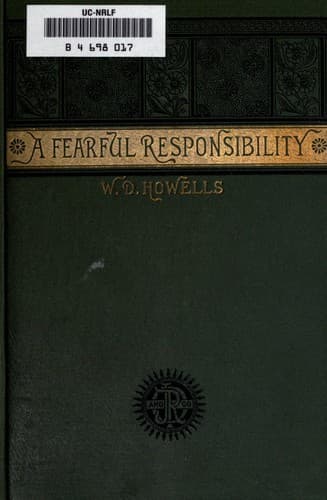
A Fearful Responsibility and Other StoriesHowells, William Dean
General
A Fearful Responsibility and Other Stories
Howells, William Dean
Manners and customs -- Fiction
"Well," said the latter, with a laugh at Elmore's pensive rapture, "I'm
as much obliged to you as if I _had_ captured her. I'll go up to the
Piazza with you, and see Cazzi."
The affair was easily arranged; Cazzi was made to feel by the consul's
intervention that the shield of American sovereignty had been extended
over the young girl whom he was to escort from Genoa, and two days later
he arrived with her. Mrs. Elmore's attack now was passing off, and she
was well enough to receive Miss Mayhew half-recumbent on the sofa where
she had been prone till her arrival. It was pretty to see her fond
greeting of the girl, and her joy in her presence as they sat down for
the first long talk; and Elmore realized, even in his dreamy withdrawal,
how much the bright, active spirit of his wife had suffered merely in
the restriction of her English. Now it was not only English they spoke,
but that American variety of the language of which I hope we shall grow
less and less ashamed; and not only this, but their parlance was
characterized by local turns and accents, which all came welcomely back
to Mrs. Elmore, together with those still more intimate inflections
which belonged to her own particular circle of friends in the little
town of Patmos, N. Y. Lily Mayhew was of course not of her own set,
being five or six years younger; but women, more easily than men, ignore
the disparities of age between themselves and their juniors; and in Susy
Stevens's absence it seemed a sort of tribute to her to establish her
sister in the affection which Mrs. Elmore had so long cherished. Their
friendship had been of such a thoroughly trusted sort on both sides that
Mrs. Stevens (the memorably brilliant Sue Mayhew in her girlish days)
had felt perfectly free to act upon Mrs. Elmore's invitation to let Lily
come out to her; and here the child was, as much at home as if she had
just walked into Mrs. Elmore's parlor out of her sister's house in
Patmos.
IV.
They briefly dispatched the facts relating to Miss Mayhew's voyage, and
her journey to Genoa, and came as quickly as they could to all those
things which Mrs. Elmore was thirsting to learn about the town and its
people. "Is it much changed? I suppose it is," she sighed. "The war
changes everything."
"Oh, you don't notice the war much," said Miss Mayhew. "But Patmos _is_
gay,--perfectly delightful. We've got one of the camps there now; and
_such_ times as the girls have with the officers! We have lots of fun
getting up things for the Sanitary. Hops on the parade-ground at the
camp, and going out to see the prisoners,--you never saw such a place."
"The prisoners?" murmured Mrs. Elmore.
"Why, _yes_!" cried Lily, with a gay laugh. "Didn't you know that we had
a prison-camp too? Some of the Southerners look real nice. I pitied
them," she added, with unabated gayety.
"Your sister wrote to me," said Mrs. Elmore; "but I couldn't realize it,
I suppose, and so I forgot it."
Public-domain text, read in full here on John Shaqi.
Reviews
Reviews
No reviews yet
Be the first to share your thoughts on this work.
Join the Discussion
Join the discussion
Sign in to leave a comment or review.
Sign InorCreate an account