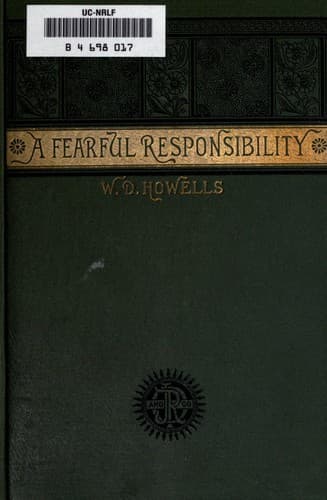
A Fearful Responsibility and Other StoriesHowells, William Dean
General
A Fearful Responsibility and Other Stories
Howells, William Dean
Manners and customs -- Fiction
gayeties. There she had been a power in her way; she had entertained,
and had helped to make some matches: but the Venetians ate nothing, and
as for young people, they never saw each other but by stealth, and their
matches were made by their parents on a money-basis. She could not adapt
herself to this foreign life; it puzzled her, and her husband's
conformity seemed to estrange them, as far as it went. It took away her
spirit, and she grew listless and dull. Even the history began to lose
its interest in her eyes; she doubted if the annals of such a people as
she saw about her could ever be popular.
There were other things to make them melancholy in their exile. The war
at home was going badly, where it was going at all. The letters now
never spoke of any term to it; they expressed rather the dogged patience
of the time when it seemed as if there could be no end, and indicated
that the country had settled into shape about it, and was pushing
forward its other affairs as if the war did not exist. Mrs. Elmore felt
that the America which she had left had ceased to be. The letters were
almost less a pleasure than a pain, but she always tore them open, and
read them with eager unhappiness. There were miserable intervals of days
and even weeks when no letters came, and when the Reuter telegrams in
the Gazette of Venice dribbled their vitriolic news of Northern
disaster through a few words or lines, and Galignani's long columns were
filled with the hostile exultation and prophecy of the London press.
III.
They had passed eighteen months of this sort of life in Venice when one
day a letter dropped into it which sent a thousand ripples over its
stagnant surface. Mrs. Elmore read it first to herself, with gasps and
cries of pleasure and astonishment, which did not divert her husband
from the perusal of some notes he had made the day before, and had
brought to the breakfast-table with the intention of amusing her. When
she flattened it out over his notes, and exacted his attention, he
turned an unwilling and lack-lustre eye upon it; then he looked up at
her.
"Did you expect she would come?" he asked, in ill-masked dismay.
"I don't suppose they had any idea of it at first. When Sue wrote me
that Lily had been studying too hard, and had to be taken out of school,
I said that I wished she could come over and pay us a visit. But I don't
believe they dreamed of letting her--Sue says so--till the Mortons'
coming seemed too good a chance to be lost. I am so glad of it, Owen!
You know how much they have always done for me; and here is a chance now
to pay a little of it back."
"What in the world shall we do with her?" he asked.
"Do? Everything! Why, Owen," she urged, with pathetic recognition of his
coldness, "she is Susy Stevens's own sister!"
"Oh, yes--yes," he admitted.
"And it was Susy who brought us together!"
"Why, of course."
"And oughtn't you to be glad of the opportunity?"
"I _am_ glad--_very_ glad."
Public-domain text, read in full here on John Shaqi.
Reviews
Reviews
No reviews yet
Be the first to share your thoughts on this work.
Join the Discussion
Join the discussion
Sign in to leave a comment or review.
Sign InorCreate an account