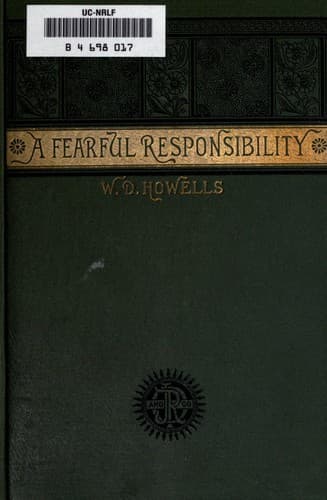
A Fearful Responsibility and Other StoriesHowells, William Dean
General
A Fearful Responsibility and Other Stories
Howells, William Dean
Manners and customs -- Fiction
"No matter! no matter! If I thought it was he, my blame is the same. And
she, poor girl,--in my lying compassion for him, I used to accuse her of
cold-heartedness, of indifference! I wonder she did not abhor the sight
of me. How has she ever tolerated the presence, the friendship, of a man
who did her this irreparable wrong? Yes, it has spoiled her life, and it
was my work. No, no, Celia! you and she had nothing to do with it,
except as I forced your consent--it was my work; and, however I have
tried openly and secretly to shirk it, I must bear this fearful
responsibility."
He dropped into a chair, and hid his face in his hands, while his wife
soothed him with loving excuses for what he had done, with tender
protests against the exaggerations of his remorse. She said that he had
done the only thing he could do; that Lily wished it, and that she never
had blamed him. "Why, I don't believe she would ever have married
Captain Ehrhardt, anyhow. She was full of that silly fancy of hers about
Dick Burton, all the time,--you know how she used always to be talking
about him; and when she came home and found she had outgrown him, she
had to refuse him, and I suppose it's that that's made her rather
melancholy." She explained that Major Burton had become extremely fat,
that his moustache was too big and black, and his laugh too loud; there
was nothing left of him, in fact, but his empty sleeve, and Lily was too
conscientious to marry him merely for that.
In fact, Elmore's regret did reflect a monstrous and distorted image of
his conduct. He had really acted the part of a prudent and conscientious
man; he was perfectly justifiable at every step: but in the retrospect
those steps which we can perfectly justify sometimes seem to have cost
so terribly that we look back even upon our sinful stumblings with
better heart. Heaven knows how such things will be at the last day; but
at that moment there was no wrong, no folly of his youth, of which
Elmore did not think with more comfort than of this passage in which he
had been so wise and right.
Of course the time came when he saw it all differently again; when his
wife persuaded him that he had done the best that any one could do with
the responsibilities that ought never to have been laid on a man of his
temperament and habits; when he even came to see that Lily's feeling was
a matter of pure conjecture with him, and that so far as he knew she had
never cared anything for Ehrhardt. Yet he was glad to have her away; he
did not like to talk of her with his wife; he did not think of her if he
could help it.
Public-domain text, read in full here on John Shaqi.
Reviews
Reviews
No reviews yet
Be the first to share your thoughts on this work.
Elsewhere in the archive
Join the Discussion
Join the discussion
Sign in to leave a comment or review.
Sign InorCreate an account