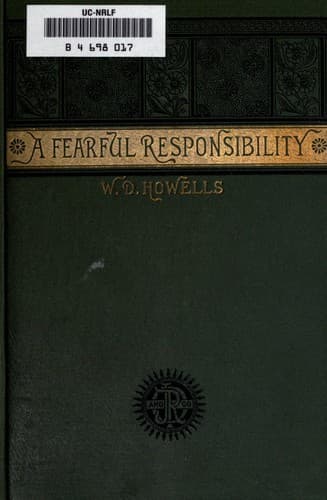
A Fearful Responsibility and Other StoriesHowells, William Dean
General
A Fearful Responsibility and Other Stories
Howells, William Dean
Manners and customs -- Fiction
They heard from time to time through her sister that her little
enterprise in Omaha was prospering, and that she was very contented out
West; at last they heard directly from her that she was going to be
married. Till then, Elmore had been dumbly tormented in his sombre moods
with the solution of a problem at which his imagination vainly
toiled,--the problem of how some day she and Ehrhardt should meet again
and retrieve the error of the past for him. He contrived this encounter
in a thousand different ways by a thousand different chances; what he so
passionately and sorrowfully longed for accomplished itself continually
in his dreams, but only in his dreams.
In due course Lily married, and from all they could understand, very
happily. Her husband was a clergyman, and she took particular interest
in his parochial work, which her good heart and clear head especially
qualified her to share with him. To connect her fate any longer with
that of Ehrhardt was now not only absurd, it was improper; yet Elmore
sometimes found his fancy forgetfully at work as before. He could not at
once realize that the tragedy of this romance, such as it was, remained
to him alone, except perhaps as Ehrhardt shared it. With him, indeed,
Elmore still sought to fret his remorse and keep it poignant, and his
final failure to do so made him ashamed. But what lasting sorrow can one
have from the disappointment of a man whom one has never seen? If Lily
could console herself, it seemed probable that Ehrhardt too had "got
along."
AT THE SIGN OF THE SAVAGE.
As they bowled along in the deliberate German express train through the
Black Forest, Colonel Kenton said he had only two things against the
region: it was not black, and it was not a forest. He had all his life
heard of the Black Forest, and he hoped he knew what it was. The
inhabitants burned charcoal, high up the mountains, and carved toys in
the winter when shut in by the heavy snows; they had Easter eggs all the
year round, with overshot mill-wheels in the valleys, and cherry-trees
all about, always full of blossoms or ripe fruit, just as you liked to
think. They were very poor people, but very devout, and lived in little
villages on a friendly intimacy with their cattle. The young women of
these hamlets had each a long braid of yellow hair down her back, blue
eyes, and a white bodice with a cat's-cradle lacing behind; the men had
bell-crowned hats and spindle-legs: they buttoned the breath out of
their bodies with round pewter buttons on tight, short crimson
waistcoats.
Public-domain text, read in full here on John Shaqi.
Reviews
Reviews
No reviews yet
Be the first to share your thoughts on this work.
Elsewhere in the archive
Join the Discussion
Join the discussion
Sign in to leave a comment or review.
Sign InorCreate an account