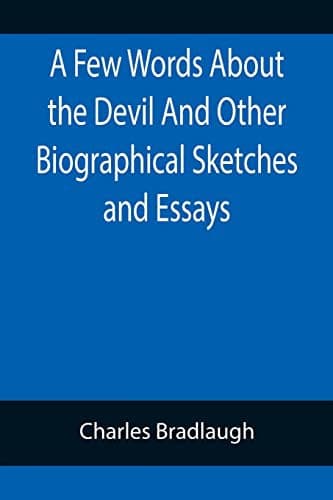
A Few Words About the Devil, and Other Biographical Sketches and EssaysBradlaugh, Charles
Religion
A Few Words About the Devil, and Other Biographical Sketches and Essays
Bradlaugh, Charles
Free thought
It has always been my ambition to enter Parliament, and at the General
Election for 1808 I, for the first time, entered the arena as a
candidate. I was beaten; but this is scarcely wonderful. I had all the
journals in England except three against me. Every idle or virulent tale
which folly could distort or calumny invent was used against me. Despite
all, I polled nearly 1,100 votes, and I obtained unasked, but not
ungratefully listened to, the public acknowledgments from the Mayor of
the borough, also from one of my competitors, Mr. Charles Gilpin, as to
the loyal manner in which I had fought the contest through.
During the election struggle libels rained from all sides. One by the
late Mr Capper, M. P., seeking reelection at Sandwich, was the monstrous
story, that in the open square at Northampton I had taken out my watch
and defied God to show his power by striking me dead in five minutes.
Challenged for his authority Mr. Capper pretended to have heard the
story from Mr. C. Gilpin, M. P., who indignantly denied being any party
to the falsehood. I insisted on an apology from Mr. Capper, which being
refused I sued him, but he died soon after the writ was served. The
story was not an original invention by Mr. Capper; it had been reported
of Abner Kneeland thirty years before, and is still a favorite one with
pious missionaries at street corners. A still more outrageous slander
was inserted in the _Razor_, a pseudo-comic weekly. I compelled
this journal to give a full apology, but not until after two years'
litigation, and a new trial had been ordered. When obliged to recant,
the Christian proprietor became insolvent, to avoid payment of the
costs. Unfortunately born poor, my life had been one continued struggle,
and the burden of my indebtedness was sorely swollen in this and similar
contests.
Probably the most severe, and to me certainly the most costly, struggle
has been on the oath question. Formerly it was a fatal objection against
the competency of a witness who did not believe in a Deity and in a
future state of rewards and punishments. Several attempts had been made
to alter the law, but they had all failed; and indeed Sir J. Trevelyan's
measures only provided for affirmation, and did not seek to abolish the
incompetency. In a case in which I was plaintiff in the Court of Common
Pleas, my evidence was objected to, and I determined to fight the matter
through every possible court, and to get the law changed if possible.
Public-domain text, read in full here on John Shaqi.
Reviews
Reviews
No reviews yet
Be the first to share your thoughts on this work.
Join the Discussion
Join the discussion
Sign in to leave a comment or review.
Sign InorCreate an account