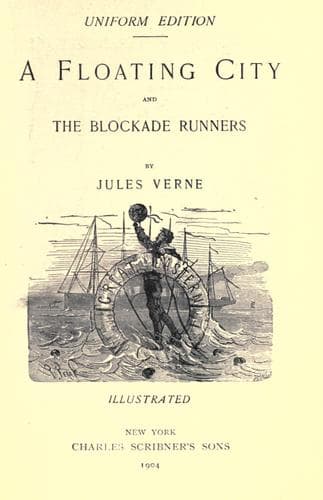
A Floating City, and The Blockade RunnersVerne, Jules
History
A Floating City, and The Blockade Runners
Verne, Jules
Great Eastern (Steamship) -- Fiction; United States -- History -- Civil War, 1861-1865 -- Blockades -- Fiction
“I was not mistaken, then; it was really you I saw on the quay a day or
two since.”
“It is most likely,” replied Fabian, “but I did not see you.”
“And you are going to America?”
“Certainly! Do you think I could spend a month’s leave better than in
travelling?”
“How fortunate that you thought of making your tour in the ‘Great
Eastern’!”
“It was not chance at all, my dear fellow. I read in the newspaper that
you were one of the passengers; and as we have not met for some years
now, I came on board, in order to make the passage with you.”
“Have you come from India?”
“Yes, by the ‘Godavery,’ which arrived at Liverpool the day before
yesterday.”
“And you are travelling, Fabian?” I asked, noticing his pale, sad face.
“To divert my mind, if I can,” interrupted Captain Mac Elwin, warmly
pressing my hand.
CHAPTER IV.
Fabian left me, to look for his cabin, which, according to the ticket he
held in his hand, was number seventy-three of the grand saloon series.
At this moment large volumes of smoke curled from the chimneys; the
steam hissed with a deafening noise through the escape-pipes, and fell
in a fine rain over the deck; a noisy eddying of water announced that
the engines were at work. We were at last going to start.
First of all the anchor had to be raised. The “Great Eastern” swung
round with the tide; all was now clear, and Captain Anderson was obliged
to choose this moment to set sail, for the width of the “Great Eastern”
did not allow of her turning round in the Mersey. He was more master of
his ship and more certain of guiding her skilfully in the midst of the
numerous boats always plying on the river when stemming the rapid
current than when driven by the ebb-tide; the least collision with this
gigantic body would have proved disastrous.
To weigh anchor under these circumstances required considerable
exertion, for the pressure of the tide stretched the chains by which the
ship was moored, and besides this, a strong south-wester blew with full
force on her hull, so that it required powerful engines to hoist the
heavy anchors from their muddy beds. An anchor-boat, intended for this
purpose, had just stoppered on the chains, but the windlasses were not
sufficiently powerful, and they were obliged to use the steam apparatus
which the “Great Eastern” had at her disposal.
At the bows was an engine of sixty-six horse-power. In order to raise
the anchors it was only necessary to send the steam from the boilers
into its cylinders to obtain immediately a considerable power, which
could be directly applied to the windlass on which the chains were
fastened. This was done; but powerful as it was, this engine was found
insufficient, and fifty of the crew were set to turn the capstan with
bars, thus the anchors were gradually drawn in, but it was slow work.
Public-domain text, read in full here on John Shaqi.
Reviews
Reviews
No reviews yet
Be the first to share your thoughts on this work.
Join the Discussion
Join the discussion
Sign in to leave a comment or review.
Sign InorCreate an account