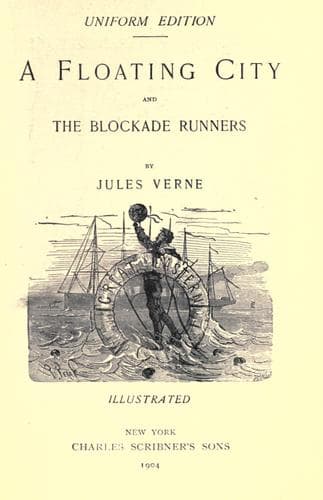
A Floating City, and The Blockade RunnersVerne, Jules
History
A Floating City, and The Blockade Runners
Verne, Jules
Great Eastern (Steamship) -- Fiction; United States -- History -- Civil War, 1861-1865 -- Blockades -- Fiction
The “Dolphin” was speeding rapidly towards the open sea. There were only
three miles more before she would be in the waters of the Atlantic; if
the pass was free at its entrance, she was saved. James Playfair was
wonderfully well acquainted with all the secrets of Charleston Bay, and
he guided his ship through the darkness with an unerring hand. He was
beginning to think his daring enterprise successful, when a sailor on
the forecastle cried,—
“A ship!”
“A ship?” cried James.
“Yes, on the larboard side.”
The fog had cleared off, and a large frigate was seen making towards the
pass, in order to obstruct the passage of the “Dolphin.” It was
necessary, cost what it might, to distance her, and urge the
steam-engine to an increase of speed, or all was lost.
“Port the helm at once!” cried the Captain.
Then he sprang on to the bridge above the engine. By his orders one of
the screws was stopped, and under the action of the other the “Dolphin,”
veering with an extraordinary rapidity avoided running foul of the
frigate, and advanced like her to the entrance of the pass. It was now a
question of speed.
James Playfair understood that in this lay his own safety, Miss Jenny’s,
her father’s, and that of all his crew.
The frigate was considerably in advance of the “Dolphin.” It was evident
from the volumes of black smoke issuing from her chimneys that she was
getting up her steam. James Playfair was not the man to be left in the
background.
“How are the engines?” cried he to the engineer.
“At the maximum speed,” replied the latter; “the steam is escaping by
all the valves.”
“Fasten them down,” ordered the Captain.
And his orders were executed at the risk of blowing up the ship.
The “Dolphin” again increased her speed; the pistons worked with
frightful rapidity; the metal plates on which the engine was placed
trembled under the terrific force of their blows. It was a sight to make
the boldest shudder.
“More pressure!” cried James Playfair; “put on more pressure!”
“Impossible!” replied the engineer; “the valves are tightly closed; our
furnaces are full up to the mouths.”
“What difference! Fill them with cotton soaked in spirits; we must pass
that frigate at any price.”
At these words the most daring of the sailors looked at each other, but
did not hesitate. Some bales of cotton were thrown into the engine-room,
a barrel of spirits broached over them, and this expensive fuel placed,
not without danger, in the red-hot furnaces. The stokers could no longer
hear each other speak for the roaring of the flames. Soon the metal
plates of the furnaces became red-hot; the pistons worked like the
pistons of a locomotive; the steam-gauge showed a frightful tension; the
steamer flew over the water; her boards creaked, and her chimneys threw
out volumes of smoke mingled with flames. She was going at a headlong
speed, but, nevertheless, she was gaining on the frigate—passed her,
distanced her, and in ten minutes was out of the channel.
Public-domain text, read in full here on John Shaqi.
Reviews
Reviews
No reviews yet
Be the first to share your thoughts on this work.
Elsewhere in the archive
Join the Discussion
Join the discussion
Sign in to leave a comment or review.
Sign InorCreate an account