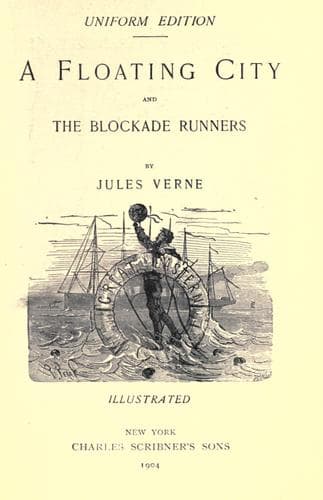
A Floating City, and The Blockade RunnersVerne, Jules
History
A Floating City, and The Blockade Runners
Verne, Jules
Great Eastern (Steamship) -- Fiction; United States -- History -- Civil War, 1861-1865 -- Blockades -- Fiction
“Saved!” cried the Captain.
“Saved!” echoed the crew, clapping their hands.
Already the Charleston beacon was disappearing in the south-west; the
sound of firing from the batteries grew fainter, and it might with
reason be thought that the danger was all past, when a shell from a
gun-boat cruising at large was hurled whizzing through the air. It was
easy to trace its course, thanks to the line of fire which followed it.
Then was a moment of anxiety impossible to describe, every one was
silent, and each watched fearfully the arch described by the projectile.
Nothing could be done to escape it, and in a few seconds it fell with a
frightful noise on the fore-deck of the “Dolphin.”
The terrified sailors crowded to the stern, and no one dared move a
step, whilst the shell was burning with a brisk crackle.
But one brave man alone among them ran up to the formidable weapon of
destruction. It was Crockston; he took the shell in his strong arms,
whilst showers of sparks were falling from it; then, with a superhuman
effort, he threw it overboard.
Hardly had the shell reached the surface of the water when it burst with
a frightful report.
“Hurrah! hurrah!” cried the whole crew of the “Dolphin” unanimously,
whilst Crockston rubbed his hands.
[Illustration: HE TOOK THE SHELL.]
Some time later the steamer sped rapidly through the waters of the
Atlantic; the American coast disappeared in the darkness, and the
distant lights which shot across the horizon indicated that the attack
was general between the batteries of Morris Island and the forts of
Charleston Harbor.
CHAPTER X.
ST. MUNGO.
The next day at sunrise the American coast had disappeared; not a ship
was visible on the horizon, and the “Dolphin,” moderating the frightful
rapidity of her speed, made quietly towards the Bermudas.
It is useless to recount the passage across the Atlantic, which was
marked by no accidents, and ten days after the departure from Queenstown
the French coast was hailed.
What passed between the Captain and the young girl may be imagined, even
by the least observant individuals. How could Mr. Halliburtt acknowledge
the devotion and courage of his deliverer, if it was not by making him
the happiest of men? James Playfair did not wait for English seas to
declare to the father and daughter the sentiments which overflowed his
heart, and, if Crockston is to be believed, Miss Jenny received his
confession with a happiness she did not try to conceal.
Thus it happened that on the 14th of February, 18—, a numerous crowd was
collected in the dim aisles of St. Mungo, the old cathedral of Glasgow.
There were seamen, merchants, manufacturers, magistrates, and some of
every denomination, gathered here. There was Miss Jenny in bridal array,
and beside her the worthy Crockston, resplendent in apple-green clothes,
with gold buttons, whilst Uncle Vincent stood proudly by his nephew.
Public-domain text, read in full here on John Shaqi.
Reviews
Reviews
No reviews yet
Be the first to share your thoughts on this work.
Elsewhere in the archive
Join the Discussion
Join the discussion
Sign in to leave a comment or review.
Sign InorCreate an account