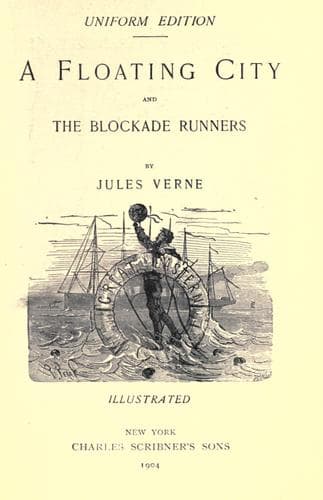
A Floating City, and The Blockade RunnersVerne, Jules
History
A Floating City, and The Blockade Runners
Verne, Jules
Great Eastern (Steamship) -- Fiction; United States -- History -- Civil War, 1861-1865 -- Blockades -- Fiction
The work of weighing anchors was resumed; with the help of the
anchor-boat the chains were eased, and the anchors at last left their
tenacious depths. A quarter past one sounded from the Birkenhead
clock-towers, the moment of departure could not be deferred, if it was
intended to make use of the tide. The captain and pilot went on the
foot-bridge; one lieutenant placed himself near the screw-signal
apparatus, another near that of the paddle-wheel, in case of the failure
of the steam-engine; four other steersmen watched at the stern, ready to
put in action the great wheels placed on the gratings of the hatchings.
The “Great Eastern,” making head against the current, was now only
waiting to descend the river with the ebb-tide.
The order for departure was given, the paddles slowly struck the water,
the screw bubbled at the stern, and the enormous vessel began to move.
The greater part of the passengers on the poop were gazing at the double
landscape of Liverpool and Birkenhead, studded with manufactory
chimneys. The Mersey, covered with ships, some lying at anchor, others
ascending and descending the river, offered only a winding passage for
our steam-ship. But under the hand of a pilot, sensible to the least
inclinations of her rudder, she glided through the narrow passages, like
a whale-boat beneath the oar of a vigorous steersman. At one time I
thought that we were going to run foul of a brig, which was drifting
across the stream, her bows nearly grazing the hull of the “Great
Eastern,” but a collision was avoided, and when from the height of the
upper deck I looked at this ship, which was not of less than seven or
eight hundred tons burden, she seemed to me no larger than the tiny
boats which children play with on the lakes of Regent’s Park or the
Serpentine. It was not long before the “Great Eastern” was opposite the
Liverpool landing-stages, but the four cannons which were to have
saluted the town, were silent out of respect to the dead, for the tender
was disembarking them at this moment; however, loud hurrahs replaced the
reports which are the last expressions of national politeness.
Immediately there was a vigorous clapping of hands and waving of
handkerchiefs, with all the enthusiasm with which the English hail the
departure of every vessel, be it only a simple yacht sailing round a
bay. But with what shouts they were answered! what echoes they called
forth from the quays! There were thousands of spectators on both the
Liverpool and Birkenhead sides, and boats laden with sight-seers swarmed
on the Mersey. The sailors manning the yards of the “Lord Clyde,” lying
at anchor opposite the docks, saluted the giant with their hearty
cheers.
Public-domain text, read in full here on John Shaqi.
Reviews
Reviews
No reviews yet
Be the first to share your thoughts on this work.
Join the Discussion
Join the discussion
Sign in to leave a comment or review.
Sign InorCreate an account