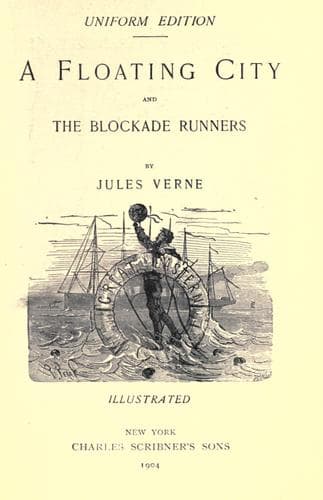
A Floating City, and The Blockade RunnersVerne, Jules
History
A Floating City, and The Blockade Runners
Verne, Jules
Great Eastern (Steamship) -- Fiction; United States -- History -- Civil War, 1861-1865 -- Blockades -- Fiction
After the ten minutes’ interval, during which some of the audience left
their seats, the second part of the concert began. The Frenchman, Paul
V——, played some charming waltzes, which were noisily encored. One of
the ship’s doctors on board, a very conceited young man, recited a
burlesque scene, a kind of parody on the “Lady of Lyons,” a drama very
much in vogue in England.
The “burlesque” was succeeded by the “entertainment.” What had Sir James
Anderson prepared under this name? Was it a conference or a sermon?
Neither the one nor the other. Sir James Anderson rose smilingly, drew a
pack of cards from his pocket, turned back his white cuffs, and
performed some tricks, the simplicity of which was redeemed by the
graceful manner in which they were done. Hurrahs and applause.
After the “Happy Moment,” and “You Remember,” sung by Mr. Norville and
Mr. Ewing, the programme announced “God Save the Queen;” but some
Americans begged Paul V——, as he was a Frenchman, to play the national
French Anthem. Immediately my agreeable countryman began the inevitable
“Partant pour la Syrie.” Energetic demands from a party of north-men,
who wished to hear the “Marseillaise,” and without being pressed
further, the obedient pianist, with a compliance which betokened rather
a musical facility than political convictions, vigorously attacked the
song of Rouget de l’Ile.
This was the grand success of the evening, and the assembly, standing,
slowly sang the “National Anthem,” which prays God to bless the Queen.
Upon the whole this soirée was as good as amateur soirées generally are;
that is to say, it was chiefly a success for the performers and their
friends. Fabian did not show himself there at all.
CHAPTER XVII.
During Monday night the sea was very stormy. Once more the partitions
began creaking, and again the luggage made its way through the saloons.
When I went on deck, about seven o’clock in the morning, the wind had
freshened, and it was raining. The officer on watch had ordered the
sails to be taken in, so that the steam-ship, left without any support,
rolled dreadfully. All this day, the 2nd of April, the deck was
deserted, even the saloons were empty, for the passengers had taken
refuge in their cabins; and two-thirds of the guests were missing at
lunch and dinner. Whist was impossible, for the tables glided from under
the players’ hands. The chess-men were unmanageable. A few of the more
fearless stretched themselves on the sofas, reading or sleeping, as many
preferred to brave the rain on deck, where the sailors, in their
oil-skin jackets and glazed hats, were sedately pacing to and fro. The
first officer, well wrapped in his macintosh, and perched on the bridge,
was on watch, and in the midst of the hurricane his small eyes sparkled
with delight. This was what the little man loved, and the steamer rolled
to his liking.
Public-domain text, read in full here on John Shaqi.
Reviews
Reviews
No reviews yet
Be the first to share your thoughts on this work.
Join the Discussion
Join the discussion
Sign in to leave a comment or review.
Sign InorCreate an account