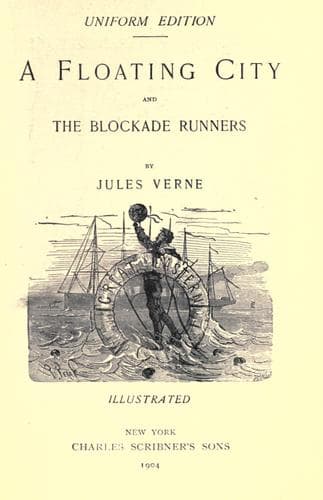
A Floating City, and The Blockade RunnersVerne, Jules
History
A Floating City, and The Blockade Runners
Verne, Jules
Great Eastern (Steamship) -- Fiction; United States -- History -- Civil War, 1861-1865 -- Blockades -- Fiction
“Very heartily yours,
DEAN PITFERGE.”
END OF “A FLOATING CITY.”
------------------------------------------------------------------------
THE BLOCKADE RUNNERS.
-------
Table of contents
Chapter Title Page
Chapter I. The “Dolphin.” 197
Chapter II. Getting under sail. 206
Chapter III. 215
Chapter IV. Crockston’s trick. 225
Chapter V. The shot from the “Iroquois,” and 235
miss Jenny’s arguments.
Chapter VI. Sullivan Island channel. 244
Chapter VII. A southern general. 252
Chapter VIII. The escape. 260
Chapter IX. Between two fires. 273
Chapter X. St. Mungo. 284
CHAPTER I.
THE “DOLPHIN.”
The Clyde was the first river whose waters were lashed into foam by a
steam-boat. It was in 1812, when the steamer called the “Comet” ran
between Glasgow and Greenock, at the speed of six miles an hour. Since
that time more than a million of steamers or packet-boats have plied
this Scotch river, and the inhabitants of Glasgow must be as familiar as
any people with the wonders of steam navigation.
However, on the 3rd of December, 1862, an immense crowd, composed of
ship-owners, merchants, manufacturers, workmen, sailors, women, and
children, thronged the muddy streets of Glasgow, all going in the
direction of Kelvin Dock, the large ship-building premises belonging to
Messrs. Tod and Mac Gregor. This last name especially proves that the
descendants of the famous Highlanders have become manufacturers, and
that they have made workmen of all the vassals of the old clan
chieftains.
Kelvin Dock is situated a few minutes’ walk from the town, on the right
bank of the Clyde. Soon the immense timber-yards were thronged with
spectators; not a part of the quay, not a wall of the wharf, not a
factory roof, showed an unoccupied place; the river itself was covered
with craft of all descriptions, and the heights of Govan, on the left
bank, swarmed with spectators.
There was, however, nothing extraordinary in the event about to take
place; it was nothing but the launching of a ship, and this was an
every-day affair with the people of Glasgow. Had the “Dolphin,” then—for
that was the name of the ship built by Messrs. Tod and Mac Gregor—some
special peculiarity? To tell the truth it had none.
Public-domain text, read in full here on John Shaqi.
Reviews
Reviews
No reviews yet
Be the first to share your thoughts on this work.
Elsewhere in the archive
Join the Discussion
Join the discussion
Sign in to leave a comment or review.
Sign InorCreate an account