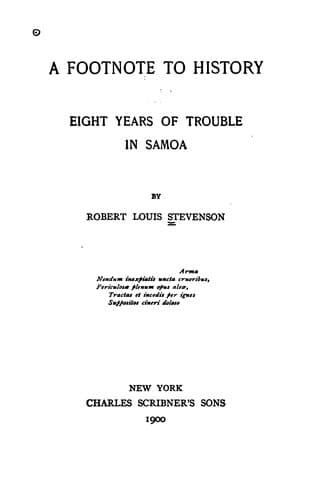
A Footnote to History: Eight Years of Trouble in SamoaStevenson, Robert Louis
History
A Footnote to History: Eight Years of Trouble in Samoa
Stevenson, Robert Louis
Samoan Islands -- History
Now, in one part of Mataafa's behaviour his purpose is beyond mistake.
Towards the provisions of the Berlin Act, his desire to be formally
obedient is manifest. The Act imposed the tax. He has paid his taxes,
although he thus contributes to the ways and means of his immediate
rival. The Act decreed the supreme court, and he sends his partisans to
be tried at Mulinuu, although he thus places them (as I shall have
occasion to show) in a position far from wholly safe. From this literal
conformity, in matters regulated, to the terms of the Berlin
plenipotentiaries, we may plausibly infer, in regard to the rest, a no
less exact observance of the famous and obscure "laws and customs of
Samoa."
But though it may be possible to attain, in the study, to some such
adumbration of an understanding, it were plainly unfair to expect it of
officials in the hurry of events. Our two white officers have
accordingly been no more perspicacious than was to be looked for, and I
think they have sometimes been less wise. It was not wise in the
president to proclaim Mataafa and his followers rebels and their estates
confiscated. Such words are not respectable till they repose on force;
on the lips of an angry white man, standing alone on a small promontory,
they were both dangerous and absurd; they might have provoked ruin;
thanks to the character of Mataafa, they only raised a smile and damaged
the authority of government. And again it is not wise in the government
of Mulinuu to have twice attempted to precipitate hostilities, once in
Savaii, once here in the Tuamasanga. The fate of the Savaii attempt I
never heard; it seems to have been stillborn. The other passed under my
eyes. A war-party was armed in Apia, and despatched across the island
against Mataafa villages, where it was to seize the women and children.
It was absent for some days, engaged in feasting with those whom it went
out to fight; and returned at last, innocuous and replete. In this
fortunate though undignified ending we may read the fact that the natives
on Laupepa's side are sometimes more wise than their advisers. Indeed,
for our last twelve months of miraculous peace under what seem to be two
rival kings, the credit is due first of all to Mataafa, and second to the
half-heartedness, or the forbearance, or both, of the natives in the
other camp. The voice of the two whites has ever been for war. They
have published at least one incendiary proclamation; they have armed and
sent into the field at least one Samoan war-party; they have continually
besieged captains of war-ships to attack Malie, and the captains of the
war-ships have religiously refused. Thus in the last twelve months our
European rulers have drawn a picture of themselves, as bearded like the
pard, full of strange oaths, and gesticulating like semaphores; while
over against them Mataafa reposes smilingly obstinate, and their own
retainers surround them, frowningly inert. Into the question of motive I
Public-domain text, read in full here on John Shaqi.
Reviews
Reviews
No reviews yet
Be the first to share your thoughts on this work.
Elsewhere in the archive
Join the Discussion
Join the discussion
Sign in to leave a comment or review.
Sign InorCreate an account