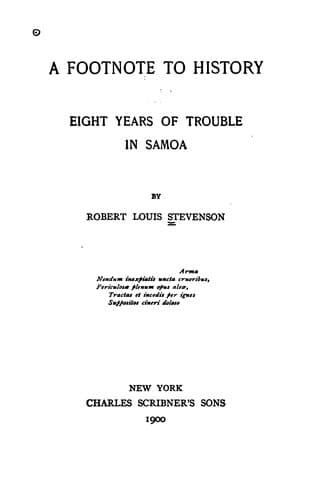
A Footnote to History: Eight Years of Trouble in SamoaStevenson, Robert Louis
History
A Footnote to History: Eight Years of Trouble in Samoa
Stevenson, Robert Louis
Samoan Islands -- History
neighbouring low-island group of the Tokelaus. We watched her put to sea
with mingled feelings. Anything were better than dynamite, but this was
not good. The men had been summoned in the name of law; they had
surrendered; the law had uttered its voice; they were under one sentence
duly delivered; and now the president, by no right with which we were
acquainted, had exchanged it for another. It was perhaps no less
fortunate, though it was more pardonable in a stranger, that he had
increased the punishment to that which, in the eyes of Samoans, ranks
next to death,--exile from their native land and friends. And the
_Lancashire Lass_ appeared to carry away with her into the uttermost
parts of the sea the honour of the administration and the prestige of the
supreme court.
The policy of the government towards Mataafa has thus been of a piece
throughout; always would-be violent, it has been almost always defaced
with some appearance of perfidy or unfairness. The policy of Mataafa
(though extremely bewildering to any white) appears everywhere consistent
with itself, and the man's bearing has always been calm. But to
represent the fulness of the contrast, it is necessary that I should give
some description of the two capitals, or the two camps, and the ways and
means of the regular and irregular government.
_Mulinuu_. Mulinuu, the reader may remember, is a narrow finger of land
planted in cocoa-palms, which runs forth into the lagoon perhaps three
quarters of a mile. To the east is the bay of Apia. To the west, there
is, first of all, a mangrove swamp, the mangroves excellently green, the
mud ink-black, and its face crawled upon by countless insects and black
and scarlet crabs. Beyond the swamp is a wide and shallow bay of the
lagoon, bounded to the west by Faleula Point. Faleula is the next
village to Malie; so that from the top of some tall palm in Malie it
should be possible to descry against the eastern heavens the palms of
Mulinuu. The trade wind sweeps over the low peninsula and cleanses it
from the contagion of the swamp. Samoans have a quaint phrase in their
language; when out of health, they seek exposed places on the shore "to
eat the wind," say they; and there can be few better places for such a
diet than the point of Mulinuu.
Public-domain text, read in full here on John Shaqi.
Reviews
Reviews
No reviews yet
Be the first to share your thoughts on this work.
Elsewhere in the archive
Join the Discussion
Join the discussion
Sign in to leave a comment or review.
Sign InorCreate an account