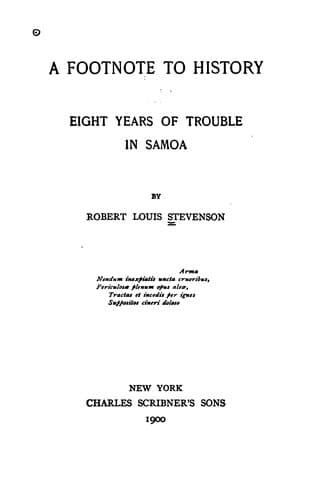
A Footnote to History: Eight Years of Trouble in SamoaStevenson, Robert Louis
History
A Footnote to History: Eight Years of Trouble in Samoa
Stevenson, Robert Louis
Samoan Islands -- History
Two European houses stand conspicuous on the harbour side; in Europe they
would seem poor enough, but they are fine houses for Samoa. One is new;
it was built the other day under the apologetic title of a Government
House, to be the residence of Baron Senfft. The other is historical; it
was built by Brandeis on a mortgage, and is now occupied by the chief
justice on conditions never understood, the rumour going uncontradicted
that he sits rent free. I do not say it is true, I say it goes
uncontradicted; and there is one peculiarity of our officials in a
nutshell,--their remarkable indifference to their own character. From
the one house to the other extends a scattering village for the Faipule
or native parliament men. In the days of Tamasese this was a brave
place, both his own house and those of the Faipule good, and the whole
excellently ordered and approached by a sanded way. It is now like a
neglected bush-town, and speaks of apathy in all concerned. But the
chief scandal of Mulinuu is elsewhere. The house of the president stands
just to seaward of the isthmus, where the watch is set nightly, and armed
men guard the uneasy slumbers of the government. On the landward side
there stands a monument to the poor German lads who fell at Fangalii,
just beyond which the passer-by may chance to observe a little house
standing back-ward from the road. It is such a house as a commoner might
use in a bush village; none could dream that it gave shelter even to a
family chief; yet this is the palace of Malietoa-Natoaitele-Tamasoalii
Laupepa, king of Samoa. As you sit in his company under this humble
shelter, you shall see, between the posts, the new house of the
president. His Majesty himself beholds it daily, and the tenor of his
thoughts may be divined. The fine house of a Samoan chief is his
appropriate attribute; yet, after seventeen months, the government (well
housed themselves) have not yet found--have not yet sought--a roof-tree
for their sovereign. And the lodging is typical. I take up the
president's financial statement of September 8, 1891. I find the king's
allowance to figure at seventy-five dollars a month; and I find that he
is further (though somewhat obscurely) debited with the salaries of
either two or three clerks. Take the outside figure, and the sum
expended on or for His Majesty amounts to ninety-five dollars in the
month. Lieutenant Ulfsparre and Dr. Hagberg (the chief justice's Swedish
friends) drew in the same period one hundred and forty and one hundred
dollars respectively on account of salary alone. And it should be
observed that Dr. Hagberg was employed, or at least paid, from government
funds, in the face of His Majesty's express and reiterated protest. In
another column of the statement, one hundred and seventy-five dollars and
seventy-five cents are debited for the chief justice's travelling
expenses. I am of the opinion that if His Majesty desired (or dared) to
Public-domain text, read in full here on John Shaqi.
Reviews
Reviews
No reviews yet
Be the first to share your thoughts on this work.
Elsewhere in the archive
Join the Discussion
Join the discussion
Sign in to leave a comment or review.
Sign InorCreate an account