"And you like Mr. Howells?" she inquired.
"Like him! everybody likes him," he cordially said.
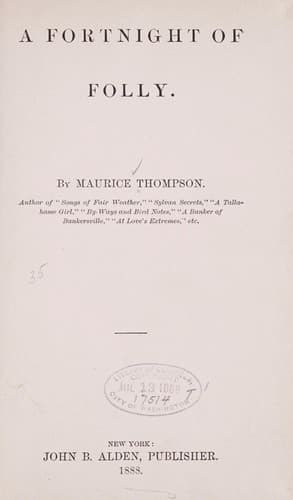
"Well, you are quite different from Miss Crabb. _She_ hates Maurice
Thompson for putting _her_ into a story."
"Oh, well," said Hubbard, indifferently, "women are not like men. They
take life more seriously. If Thompson had had more experience he would
not have tampered with a newspaper woman. He's got the whole crew down
on him. Miss Stackpole hates him almost as fiercely as she hates Henry
James."
"I don't blame her," exclaimed Mrs. Philpot, "it's mean and contemptible
for men to caricature women."
"Oh, I don't know," yawned Hubbard, "it all goes in a lifetime."
At this opportune moment Miss Crabb and Miss Stackpole joined them,
coming arm in arm. Miss Crabb looking all the more sallow and slender in
comparison with the plump, well-fed appearance of her companion.
"May I introduce you to Miss Crabb of the Ringville _Star_, Mr.
Hubbard," Miss Stackpole asked, in a high but by no means rich voice,
as she fastened her steady, button-like eyes on Mrs. Philpot.
Hubbard arose lazily and went through the process of introduction
perfunctorily, giving Miss Crabb a sweeping but indifferent glance.
"There's an impromptu pedestrian excursion on hand," said Miss
Stackpole, "and I feel bound to go. One of the gentlemen has discovered
a hermit's cabin down a ravine near here, and he offers to personally
conduct a party to it. You will go, Mr. Hubbard?"
"Go! I should remark that I will. You don't get a scoop of that item, I
assure you."
Miss Stackpole was a plump and rather pretty young woman, fairly well
dressed in drab drapery. She stood firmly on her feet and had an air
of self-reliance and self-control in strong contrast with the fussy,
nervous manner of Miss Crabb.
Mrs. Philpot surveyed the two young women with that comprehensive,
critical glance which takes in everything that is visible, and quickly
enough she made up her comparison and estimate of them.
She decided that Miss Crabb had no style, no _savoir faire_, no repose;
but then Miss Stackpole was forward, almost impudent in appearance, and
her greater ease of manner was really the ease that comes of a long
training in intrusiveness, and of rubbing against an older civilization.
She felt quite distinctly the decided dash of vulgarity in the three
newspaper representatives before her, and she could not help suspecting
that it would not be safe to judge the press reporters by these
examples.
The question arose in her mind whether after all Howells and Henry James
and Maurice Thompson had acted fairly in taking these as representative
newspaper people.
She had met a great many newspaper people and had learned to like them
as a class; she had many good and helpful friends among them.
Public-domain text, read in full here on John Shaqi.
Reviews
Reviews
No reviews yet
Be the first to share your thoughts on this work.
Join the Discussion
Join the discussion
Sign in to leave a comment or review.
Sign InorCreate an account