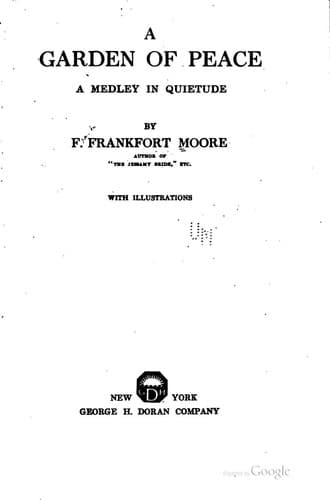
A Garden of Peace: A Medley in QuietudeMoore, Frank Frankfort
General
A Garden of Peace: A Medley in Quietude
Moore, Frank Frankfort
Gardens -- Fiction
I could understand the inspiration that should result in sermons from
stones--such as the poet's forgetting that his mission was not that
of the sermonising missionary, but of the singer of such creations of
beauty as offer themselves to nestle to the heart of man--when walking
round the gracious curve that the grass path makes till it is arrested
by the break in the wall where the postern gate once hung, guarded by
the sentinel whose feet must have paced this grass path until no blade
of grass remained on it.
Early every summer the glory of the snapdragons and the wallflowers is
overwhelmed for a time by the blossom of the pear-trees and the plums
which spread themselves abroad and sprawl even over the top of the wall.
By their aid the place is transformed for a whole month in a fruitful
year. In 1917 it was as a terrific snowstorm had visited us. It was with
us as with all our neighbours, a wonderful year for pears, apples, and
plums. Pink and white and white and pink hid the world and all that
appertained to it from our eyes, and when the blossoms were shed we
were afraid to set a foot upon the grass path: it would have been a
profanity to crush that delicate embroidery. It seemed as if Nature had
flung down her copious mantle of fair white satin before our feet; but
we bowed our heads conscious of our unworthiness and stood motionless in
front of that exquisite carpeting.
[Illustration: 0304]
And then day after day the lovely things of the wall that had been
hidden asserted themselves, and a soft wind swept the path till all the
green of the new grass path flowed away at our feet, and Nature
seemed less virginal. Then came the babes--revealed by the fallen
blossoms--plump little cherubic faces of apples, graver little papooses
of the russet Indian tint, which were pears, and smaller shy things
peeping out from among the side shoots, which we could hardly recognise
as plums; rather a carcanet of chrysoprase they seemed, so delicately
green in their early days, before each of them became like the ripe
Oriental beauty, the _nigra sed formoasa_, of the Song of Solomon, and
for the same reason: “Because the sun hath looked upon me,” she cried.
When the sun had looked upon the fruit that clustered round the clefts
in our wall, he was as one of the sons of God who had become aware for
the first time of the fact that the daughters of men were fair; and the
whole aspect of the world was changed.
Public-domain text, read in full here on John Shaqi.
Reviews
Reviews
No reviews yet
Be the first to share your thoughts on this work.
Elsewhere in the archive
Join the Discussion
Join the discussion
Sign in to leave a comment or review.
Sign InorCreate an account