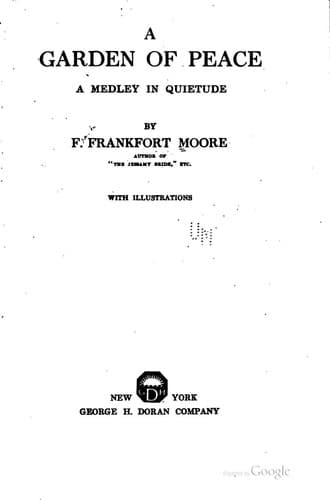
A Garden of Peace: A Medley in QuietudeMoore, Frank Frankfort
General
A Garden of Peace: A Medley in Quietude
Moore, Frank Frankfort
Gardens -- Fiction
Is there any part of a garden that is more beautiful than the orchard?
At every season it is lovely. I cannot understand how it is that the
place for fruitgrowing is in so many gardens kept away from what is
called the ornamental part. I cannot understand how it has come about
that flowering shrubs are welcomed and flowering apples discouraged in
the most favoured situations. When a considerable number of the
former have lost their blossoms, they are for the rest of the year as
commonplace as is possible for a tree to be; but when the apple-blossom
has gone, the houghs that were pink take on a new lease of beauty, and
the mellow glory of the season of fruitage lasts for months. The berry
of the gorse which is sometimes called a gooseberry, is banished like
a Northumberland cow-pincher of the romantic period, beyond the border;
but a well furnished gooseberry bush is as worthy of admiration as
anything that grows in the best of the borders, whether the fruit is
green or red. And then look at the fruit of the white currant if you
give it a place where the sun can shine through it--clusters shining
with the soft light of the Pleiades or the more diffuse Cassiopea; and
the red currants--well, I suppose they are like clusters of rubies; but
everything that is red is said to be like a ruby; why not talk of the
red currant bush as a firmament that holds a thousand round fragments of
a fractured Mars?
There was a time in England when a garden meant a place of fruit rather
than flowers, but by some freak of fashion it was decreed that anything
that appealed to the sense of taste was “not in good taste”--that was
how the warrant for the banishment of so much beauty was worded--“not in
good taste.” I think that the decree is so closely in harmony with
the other pronouncements of the era of _mauvaise honte_--the era of
affectations--when the “young lady” was languid and insipid--“of dwarf
habit,” as the catalogues describe such a growth, and was never
allowed to be a girl--when fainting was esteemed one of the highest
accomplishments of the sex, and everything that was natural was
pronounced gross--when the sampler, the sandal, and the simper wexe the
outward and visible signs of an inward and affected femininity: visible?
oh, no; the sandal was supposed to be invisible; if it once appeared
even to the extent of a taper toe, and attention was called to its
obtrusion, there was a little shriek of horror, and the “young lady” was
looked at askance as demie-vierge. It was so much in keeping with the
rest of the parcel to look on something that could be eaten as something
too gross to be constantly in sight when growing naturally, that I think
the banishment of the apple and the pear and the plum and the gooseberry
to a distant part of the garden must be regarded as belonging to the
same period. But now that the indelicacy of the super-delicacy of
that era has passed--now that the shy sandal has given place to the
Public-domain text, read in full here on John Shaqi.
Reviews
Reviews
No reviews yet
Be the first to share your thoughts on this work.
Elsewhere in the archive
Join the Discussion
Join the discussion
Sign in to leave a comment or review.
Sign InorCreate an account