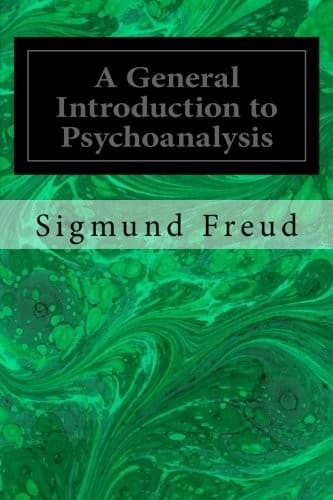
A General Introduction to PsychoanalysisFreud, Sigmund
Science
A General Introduction to Psychoanalysis
Freud, Sigmund
Psychoanalysis
In the representation of parts of speech that denote thought relations,
such as _because_, _therefore_, _but_, etc., you have no such aids;
these constituent parts of the text will therefore be lost in your
translation into images. In the same way, the dream-work resolves the
content of the dream thought into its raw material of objects and
activities. You may be satisfied if the possibility is vouchsafed you to
suggest certain relations, not representable in themselves, in a more
detailed elaboration of the image. In quite the same way the dream-work
succeeds in expressing much of the content of the latent dream thought
in the formal peculiarities of the manifest dream, in its clearness or
vagueness, in its division into several parts, etc. The number of
fragmentary dreams into which the dream is divided corresponds as a rule
to the number of main themes, of thought sequences in the latent dream;
a short preliminary dream often stands as an introduction or a
motivation to the complementary dream which follows; a subordinate
clause in dream thought is represented in the manifest dream as an
interpolated change of scene, etc. The form of the dream is itself,
therefore, by no means without significance and challenges
interpretation. Different dreams of the same night often have the same
meaning, and testify to an increasing effort to control a stimulus of
growing urgency. In a single dream a particularly troublesome element
may be represented by "duplicates," that is, by numerous symbols.
By continually comparing dream thought with the manifest dream that
replaces it, we learn all sorts of things for which we were not
prepared, as for instance, the fact that even the nonsense and absurdity
of the dream have meaning. Yes, on this point the opposition between the
medical and psychoanalytic conception of the dream reaches a climax not
previously achieved. According to the former, the dream is senseless
because the dreaming psychic activity has lost all power of critical
judgment; according to our theory, on the other hand, the dream becomes
senseless, whenever a critical judgment, contained in the dream thought,
wishes to express the opinion: "It is nonsense." The dream which you all
know, about the visit to the theatre (three tickets 1 Fl. 50 Kr.) is a
good example of this. The opinion expressed here is: "It was _nonsense_
to marry so early."
In the same way, we discover in interpretation what is the significance
of the doubts and uncertainties so often expressed by the dreamer as to
whether a certain element really occurred in the dream; whether it was
this or something else. As a rule these doubts and uncertainties
correspond to nothing in the latent dream thought; they are occasioned
throughout by the working of the dream censor and are equivalent to an
unsuccessful attempt at suppression.
Public-domain text, read in full here on John Shaqi.
Reviews
Reviews
No reviews yet
Be the first to share your thoughts on this work.
Elsewhere in the archive
Join the Discussion
Join the discussion
Sign in to leave a comment or review.
Sign InorCreate an account