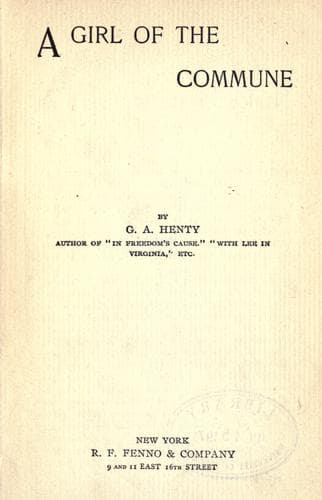
Paris (France) -- History -- Commune, 1871 -- Fiction
Mary did not answer, but gave an almost imperceptible shrug of her
shoulders, expressing clearly her absolute indifference to other
people's tastes so long as she satisfied her own. Mary was indeed
decided in most of her opinions. Although essentially feminine in most
respects, she and the set to which she had belonged at Girton, had
established it as a principle to their own satisfaction, that feminine
weaknesses were to be sternly discouraged as the main cause of the
position held relatively to men. Thus they cultivated a certain
brusqueness of speech, expressed their opinion uncompromisingly, and
were distinguished by a certain plainness in the fashion of their gowns,
and by the absence of trimmings, frillings, and similar adornments.
At heart she was as fond of pretty things as other girls of her age, and
had, when she attired herself, been conscious that she felt a greater
satisfaction at her appearance than she ought to have done, and doubted
whether she had not made an undue concession to the vanities of society
in the matter of her laces and flowers. She had, however, soothed her
conscience by the consideration that she was at home but for a short
time, and while there she might well fall in with her parents' views, as
she would be soon starting for Germany to enter upon earnest work. Her
father's remarks then were in a sense satisfactory to her, as they
showed that, although she had made concessions, she had at least gone
but half-way.
The dinner passed off well. Mary was fortunate in being taken down by a
gentleman who had advanced views on the necessity of British
agriculturists adopting scientific farming if they were to hold their
own against foreign producers, and she surprised him by the interest she
exhibited in his theories. So much so, that he always spoke of her
afterwards as one of the most intelligent young women he had ever met.
Mr. Brander was in remarkably good spirits. On such occasions he
entirely dropped his profession, and showed a keen interest in all
matters connected with the land. No one would that evening have supposed
that his mind was in the smallest degree preoccupied by grave matters of
any kind.
CHAPTER II.
As his father had said, Cuthbert Harrington's tastes differed widely
from his own. Cuthbert was essentially a Londoner, and his friends would
have had difficulty in picturing him as engaged in country pursuits.
Indeed, Cuthbert Hartington, in a scarlet coat, or toiling through a
turnip field in heavy boots with a gun on his shoulder, would have been
to them an absurd anomaly.
It was not that he lacked strength; on the contrary, he was tall and
well, if loosely, built. Grace is not a common manly attribute, but he
possessed it to an eminent degree. There was a careless ease in his
manner, an unconscious picturesqueness in his poses, a turn, that would
have smacked of haughtiness had there been the slightest element of
pride in his disposition, in the curve of the neck, and well-poised
head.
Public-domain text, read in full here on John Shaqi.
Reviews
Reviews
No reviews yet
Be the first to share your thoughts on this work.
Join the Discussion
Join the discussion
Sign in to leave a comment or review.
Sign InorCreate an account