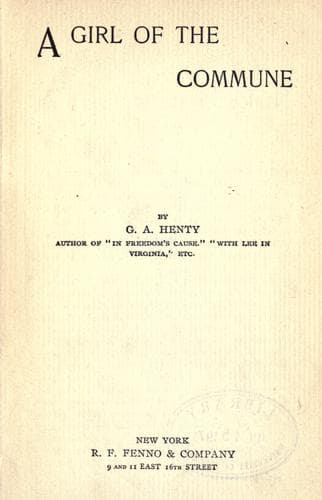
Paris (France) -- History -- Commune, 1871 -- Fiction
It needed somewhat close packing for the men to rest themselves, but the
crowding was more than counter balanced by the warmth, and it was not
long before all were asleep. At one o'clock in the morning, they were
awakened by a tremendous cannonade. All the forts round Paris had
suddenly opened fire upon the German positions. Believing that the enemy
must have obtained a knowledge of the approaching sortie and were
anticipating it by assaulting the forts, the colonel ordered the men to
stand to their arms. In an hour the firing ceased and all was quiet
again. The men, with a little grumbling at being taken out and chilled
in the night air, returned to the barn. At four o'clock they were again
aroused by the fire being resumed.
"We may as well be off, lads," the colonel said, "we have some distance
to march, and it is not worth while to turn in again."
Between the reports of the guns a dull rumbling sound could be heard.
"The artillery and train are on the move," Cuthbert said to Rene, who
was next to him in the ranks, "so we shall not be too soon if we are to
take our share in the early part of the fighting."
They left the main road and followed the fields, as many of them were
well acquainted with the country, and they had no difficulty in keeping
in the right direction. The men marched at ease, each picking his way as
best he could across the ground, which was broken up into small
enclosures and gardens. They halted outside a village on the banks of
the Marne where one of the pontoon bridges had been thrown across. Here
they piled arms and endeavored to keep themselves warm by stamping their
feet and swinging their arms.
Soon after morning dawned, heavy firing broke out suddenly behind them.
The colonel had learnt at Charenton that General Vinoy, with 15,000 men,
was to advance from between the southern forts to attack Ville Juif and
the heights of Mesly, so as to induce a concentration of the enemy in
that direction, and so to diminish the difficulties of the main advance.
For a time there was a sound of cannon only, then came a crackle of
musketry telling that the advance had begun. The battery on the
commanding position of St. Maur opened in earnest, and was aided by
several batteries of field artillery, the din being now incessant.
Gradually the rattle of musketry became fainter, showing that the French
were driving the enemy back, and a mounted officer riding past told them
that Montmesly was taken. The news raised the spirits of the soldiers to
the highest point, and their impatience was becoming almost
uncontrollable, when the order arrived for them to advance, and the
troops at once began to cross the six pontoon bridges that had been
thrown at different points across the Marne.
Public-domain text, read in full here on John Shaqi.
Reviews
Reviews
No reviews yet
Be the first to share your thoughts on this work.
Elsewhere in the archive
Join the Discussion
Join the discussion
Sign in to leave a comment or review.
Sign InorCreate an account